
Attic Insulation Replacement in Palo Alto, CA
Our Attic Insulation services for replacement in Palo Alto typically run between $1,800 and $4,500 for a single-story home, depending on square footage, existing material type, and how much air sealing work the attic floor needs before new insulation goes in. Most jobs are completed in one day. The result is a documented R-value you can verify, not a promise about comfort you have to take on faith.
Replacement is different from an Attic Insulation Top-Up. When the existing insulation is damaged, contaminated, compressed flat, or was never installed correctly in the first place, adding more material on top of the problem does not fix it. You pull what’s there, seal the attic floor properly, and then insulate. That sequence matters. At Topside Attic Insulation Palo Alto, we have followed it on every job since 2016, and we won’t change the order because skipping air sealing before blowing new insulation is how you end up with R-38 on paper and a heating bill that makes no sense.
If you’re trying to decide whether replacement is actually what your attic needs, or whether a competitor’s quote is reasonable, call us at (650) 352-3577. A live person answers. We also offer a Free Second Opinion on any written estimate – bring us the quote and we’ll read it with you, line by line. For a full picture of everything replacement fits into, visit our Attic Insulation in Palo Alto page.
When You Need Attic Insulation Replacement
Not every attic insulation problem calls for replacement. Some do. Here are the situations where pulling the old material out is the right call, not the expensive upsell.
- Rodent or pest contamination. Palo Alto’s mature tree canopy and older housing stock – particularly around Old Palo Alto, Crescent Park, and the Midtown neighborhood – create conditions where rats and squirrels move through attic spaces regularly. Once insulation has been used as nesting material or is saturated with urine, it cannot be sanitized in place. It has to come out.
- Water intrusion or mold growth. Cellulose and fiberglass batts both lose most of their thermal value when wet. A roof leak or condensation problem that went unnoticed for a season can collapse R-value by 30 to 50 percent in affected areas. If the material clumps, smells musty, or shows discoloration, replacement is the only answer.
- Insulation installed before 2000 that has never been replaced. Homes built in the 1950s through 1980s in areas like Barron Park, Downtown Palo Alto, and the College Terrace district often have original insulation that has compacted to a fraction of its installed depth. Fiberglass batts don’t spring back. Blown cellulose settles. What read as R-19 at installation may be performing at R-10 or below.
- Vermiculite or deteriorating older material. A small percentage of Palo Alto homes built before 1980 still have vermiculite insulation in the attic. This material warrants testing before any disturbance. If asbestos-containing vermiculite is confirmed, abatement by a licensed contractor is required before any new insulation can go in. We don’t perform asbestos abatement, but we can tell you what we’re looking at when we inspect.
- Air sealing is impossible without removal. If the attic floor is packed with debris, old ductwork, or insulation that was blown directly over unsealed top plates and penetrations, you can’t reach the air-leakage points without clearing the space first. We seal top plates, can lights, plumbing and electrical penetrations, and HVAC chases before any new insulation goes down. That work requires access.
- Energy bills that don’t reflect the insulation that’s supposedly there. If your PG&E bills are high relative to comparable homes in Palo Alto’s climate zone (Zone 3, temperate but with real summer heat gain), and a previous contractor told you the insulation was fine, a blower-door test – a pressurization measurement that shows, in one number, how much conditioned air your building envelope is losing – will tell you what the visual inspection missed.
Our Attic Insulation Replacement Process
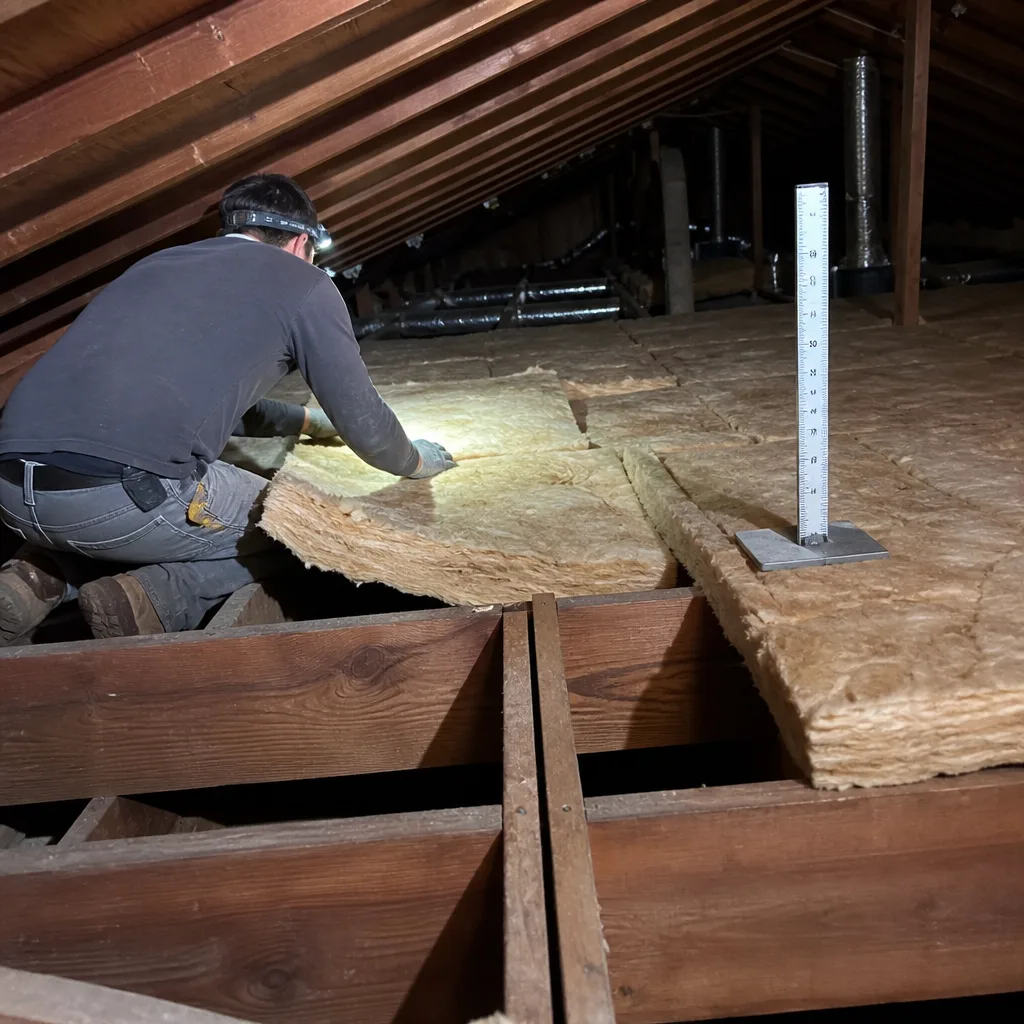
This is the order of operations on every replacement job we run. It doesn’t change based on how large the job is or how tight the schedule is.
- Written scope and price before anyone starts. Under Haven Standard Clause 1, you receive a flat written price, a written scope of work, and a written warranty before we lift a tool. The price on that document is the price on the invoice. No surprises discovered mid-job that somehow weren’t visible during the estimate.
- Pre-job blower-door baseline (where applicable). Before we pull a single bag of old insulation, we record a blower-door reading – the number in CFM50, meaning cubic feet per minute at 50 pascals of pressure differential – that documents how airtight your home’s envelope is right now. This is the “before” number we’ll compare against when the job is done.
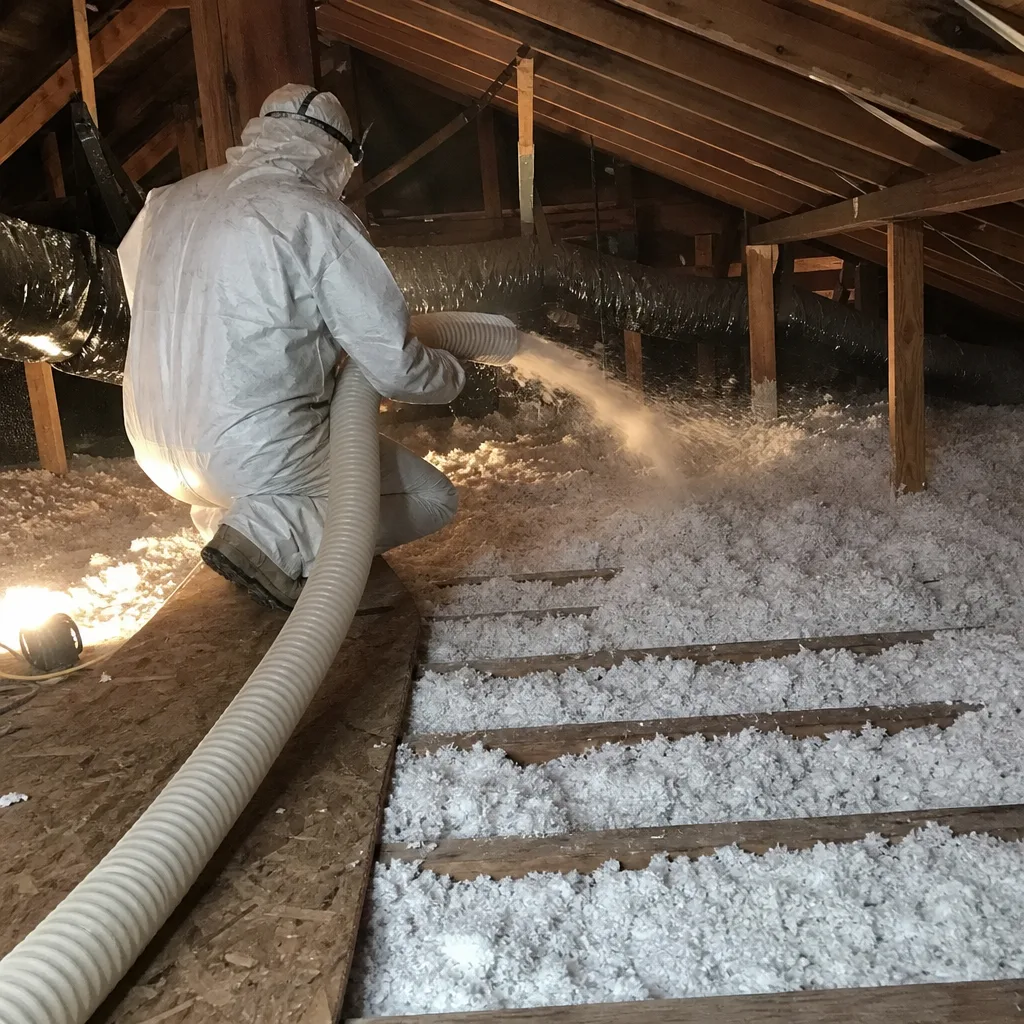
- Full insulation removal. We use commercial-grade vacuum equipment to remove existing blown-in material and extract deteriorated batts. All removed material is bagged and hauled off the property. Depending on what we find – nesting material, waste, moisture-damaged wood – the crew will document the condition photographically before cleanup so you have a record of what was actually in your attic.
- Air sealing of the attic floor. This step is the prerequisite, not the upsell. Every accessible top plate gap, recessed light housing, plumbing penetration, HVAC chase opening, and electrical knockout gets sealed with fire-rated spray foam or acoustical sealant before any new insulation is installed. In Palo Alto’s older housing stock, especially homes built before 1975, we regularly find top plates that were never sealed at original construction. In some Crescent Park homes we’ve worked in, a single row of unsealed top plates was responsible for more air loss than every other penetration in the attic combined.
- New insulation installation to specified R-value. We install to California Title 24 minimums for Climate Zone 3, which calls for R-38 in attic floors for most residential projects – though we’ll discuss with you whether R-49 makes sense given your home’s profile. Material is selected based on the application: blown-in fiberglass from Johns Manville or Owens Corning for most attic floors, GreenFiber cellulose where appropriate for existing wall cavities accessed through the attic, or open-cell spray foam in specific air-barrier applications. No proprietary product lock-in; we use what the assembly calls for.
- Post-job blower-door test and documented photo record. When the work is done, we run the blower-door again. The before-and-after numbers go into the documentation package you receive at job close – along with photos of the sealed penetrations, the installed insulation depth, and the finished attic floor. You don’t have to trust that the air sealing was done. You can see the CFM50 drop on paper.
Attic Insulation Replacement Pricing in Palo Alto
Attic insulation replacement in Palo Alto costs more than a simple top-up, and the difference is real work: removal, haul-off, air sealing, and reinstallation are all separate labor steps. Here are the ranges we see on actual jobs in this market.
| Scope | Typical Range (Palo Alto) | Notes |
|---|---|---|
| Removal only (no reinstall) | $700 – $1,400 | Includes haul-off; pricing varies by depth and material type |
| Removal + air sealing + blown-in reinstall (1,000 sq ft attic floor) | $2,200 – $3,200 | Includes blower-door before/after; assumes no contamination remediation |
| Removal + air sealing + blown-in reinstall (1,500 – 2,000 sq ft) | $3,000 – $4,500 | Typical for single-story ranch or two-story with large attic footprint |
| Contamination remediation add-on (rodent nesting, heavy debris) | $400 – $900 added | Sanitizing, deodorizing, and additional bagging |
| Spray foam air sealing (complex attic penetration count) | $300 – $700 added | Homes with many can lights or open top plates; common in pre-1980 Palo Alto stock |
What moves the price up: attic access difficulty (low-pitch roofs and small hatches slow removal considerably), the volume of contaminated material, how many unsealed penetrations the air sealing step uncovers, and whether ductwork or HVAC equipment needs to be temporarily moved. What keeps it down: a clean, accessible attic with minimal debris and a straightforward Blown-In Attic Insulation reinstall to R-38.
Palo Alto’s housing market runs toward older homes, and older homes have more penetrations to seal. A 1,400-square-foot attic in a 1960s Midtown ranch with original uninsulated top plates and 14 can lights that were never air-sealed will take more sealing labor than the same-sized attic in a 1990s construction in South Palo Alto. We factor that into the written price – not into a change order you see after the crew is already up there.
Under the Haven Standard, you receive a written price before any work starts. Call (650) 352-3577 to schedule an estimate. The estimate is free, and the price on the written scope is the price you pay.
FAQs – Attic Insulation Replacement
How long does attic insulation replacement take in a typical Palo Alto home?
Most attic insulation replacement jobs in Palo Alto are completed in a single day. A 1,200- to 1,500-square-foot attic floor with a standard removal, air-sealing pass, and Attic Baffles & Ventilation Prep for blown-in reinstall typically runs six to eight hours of crew time. Larger attics, heavily contaminated spaces, or attics with difficult access (low-pitch rafters, small hatch openings common in some older Palo Alto bungalows) may push into a second day. We’ll tell you which category your attic falls into before we schedule, not after we arrive.
Do I have to replace all the insulation, or can you just replace the damaged sections?
Partial replacement is possible when contamination or damage is clearly localized, but it’s less common than homeowners expect. The main reason: the air sealing step requires access to the attic floor. If part of the floor needs to be cleared for sealing, the cost savings from leaving other sections in place often disappear. In practice, when we’re already doing removal in 60 percent of an attic, the economics usually favor doing the full floor – especially in older Palo Alto homes where the remaining insulation has compacted significantly. We’ll give you the cost comparison in writing so you can decide.
Is attic insulation replacement covered by homeowners insurance in California?
Replacement is covered in some cases. If the damage is the result of a covered peril – a roof leak that caused water intrusion, or a confirmed rodent infestation that originated from a structural gap – many policies will cover removal and reinstallation, minus the deductible. Wear-and-tear degradation and original installation deficiencies are generally not covered. We provide a Documented Photo Record on every job, which insurance adjusters routinely request when evaluating a claim. If you’re filing a claim, having that documentation from before and after the work matters. Call (650) 352-3577 and we can walk you through what documentation we produce.
What R-value do I need in my Palo Alto attic after replacement?
California Title 24, Climate Zone 3 (which covers Palo Alto) sets R-38 as the code minimum for attic floors in most residential retrofits. R-49 is achievable at a modest additional cost – roughly $0.10 to $0.20 per square foot more in material – and makes sense if you plan to stay in the home long-term or if your attic is subject to significant summer heat gain from a south- or west-facing roof slope. We’ll note both options in the written scope with the cost difference spelled out, and you choose. What we won’t do is install to a lower R-value without noting it explicitly.
What’s Included When Topside Attic Insulation Palo Alto Does Your Replacement
Every attic insulation replacement job run by Wes Okafor’s team at Topside Attic Insulation Palo Alto includes the same documentation package, regardless of job size. You receive: a written price and scope before work starts; a Documented Photo Record showing pre-removal attic conditions, air sealing points, and finished insulation depth; before-and-after blower-door readings (CFM50) where applicable; and a written warranty backed by the 365-Day Done Right Promise. If something isn’t right within a year of completion, we make it right – in writing, not over the phone.
We source insulation materials from manufacturers including Johns Manville, Owens Corning, and GreenFiber. The material choice is driven by the assembly, not by margin. On our home page you’ll find the full list of services we provide across the building envelope – from crawl space encapsulation to attic air sealing to home energy audits – in case your project ends up touching more than one system.
Attic insulation replacement isn’t the most visible upgrade a Palo Alto homeowner can make, but the blower-door numbers make the result legible. A reading that goes from 3,800 CFM50 to 1,900 CFM50 after removal, sealing, and reinstall is a 50-percent reduction in envelope air loss. That’s a specific, documentable outcome. We think that’s worth more than a comfort guarantee with no number behind it.
To schedule a free estimate or request a second opinion on a quote you’ve already received, call (650) 352-3577. A live person answers. The written price comes before any work starts – that’s not a policy we make exceptions to.
Written by Wes Okafor, Owner at Topside Attic Insulation Palo Alto, serving Palo Alto since 2016.