
Johns Manville Attic Insulation: The Palo Alto Owner’s Guide
We stock and install Johns Manville-compatible blown-in fiberglass and mineral wool attic insulation in Palo Alto, with most retrofits running $2.80-$4.20 per square foot installed depending on the target R-value and the condition of the existing air sealing. Same-day installation is available for most homes under 3,000 square feet when we scope the job before noon. Homeowners usually discover their Johns Manville insulation is failing when PG&E bills spike during Palo Alto’s shoulder seasons, when upstairs bedrooms won’t hold temperature despite the furnace running, or when a home energy audit reveals the original R-30 batts have compressed to R-19 or below after a decade of foot traffic and rodent activity in the attic.
Which Johns Manville Models This Applies To
Johns Manville produces several attic insulation lines that appear in Palo Alto homes, and the product you need depends on what’s currently in place and what your building envelope requires. The Climate Pro blown-in fiberglass series, identifiable by the white and green bag labeling and a settled density of 0.5-0.6 pounds per cubic foot, is the most common retrofit material we remove and replace in Midtown and Old Palo Alto ranch homes built between 1950 and 1975. The Spider custom spray-applied fiberglass system, which uses an adhesive binder to create a seamless blanket, appears in tighter homes where loose fill would migrate through recessed can light penetrations. For mineral wool, the TempControl batts, gray and noticeably denser than fiberglass, show up in fire-rated assemblies and homes where the owner prioritized sound attenuation between floors.
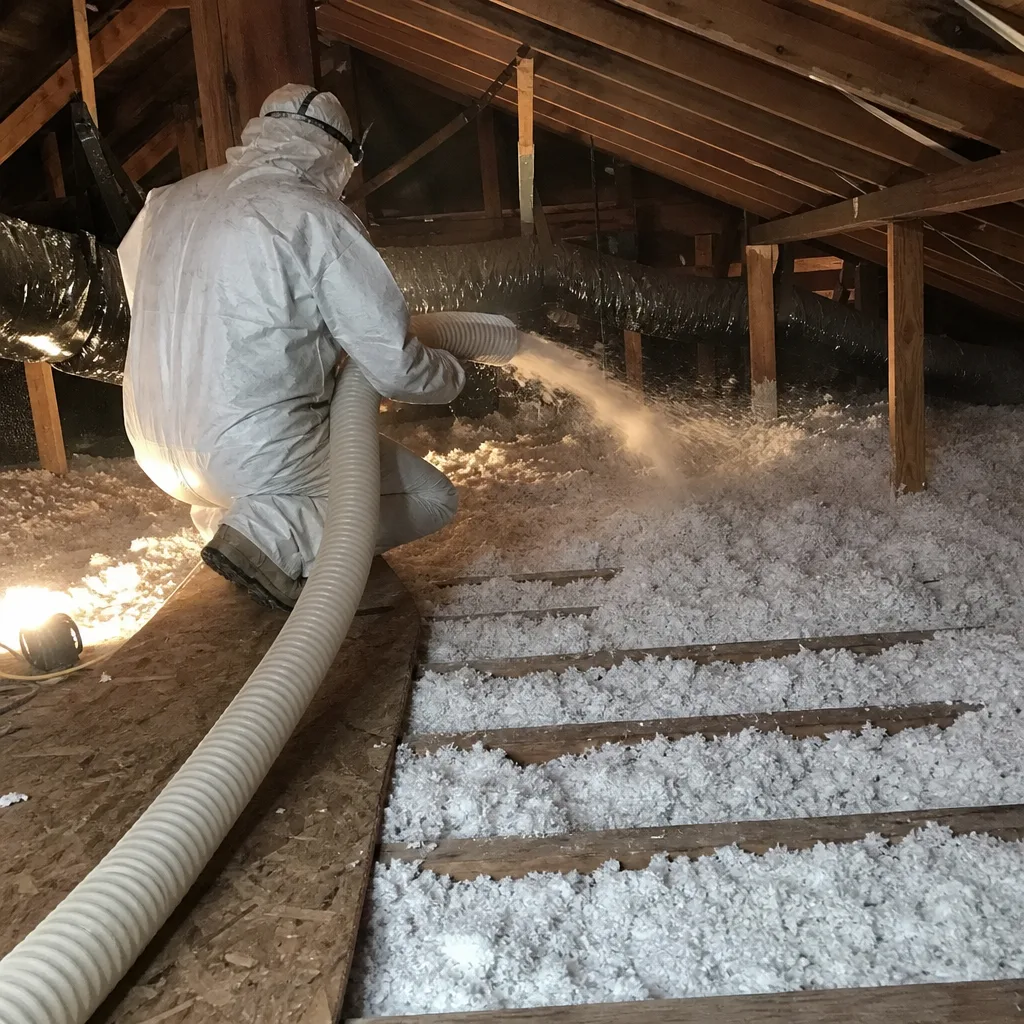
Identification matters because Johns Manville’s blown-in fiberglass requires specific machine settings: the Climate Pro line needs a 2.5-inch orifice plate and air pressure between 3.2 and 3.8 PSI at the hose, while aftermarket loose fill from other manufacturers often specifies 3.5+ PSI and will over-fluff if run through JM-calibrated equipment. We verify the existing product by bag remnants left in the attic, by settled depth measurement against labeled coverage charts, and by the staple pattern on any remaining batts. Topside Attic Insulation Palo Alto is an independent service provider, not affiliated with Johns Manville. We also stock parts for Reflectix radiant barrier systems when the ductwork in a Palo Alto attic needs complementary treatment.
Signs Your Johns Manville Attic Insulation Is Failing
- Uneven temperature distribution between rooms. When Climate Pro loose fill migrates away from eaves or settles around attic access hatches, the thermal boundary develops gaps. We see this most in Palo Alto’s Eichler and Eichler-influenced homes where the flat roof geometry and open-beam ceiling detail leave minimal attic cavity to work with; the insulation that remains reads full depth at the center but thins to nothing at the perimeter where heat loss actually matters.
- Ice damming or persistent moisture staining at the roof sheathing. This sounds counterintuitive in Palo Alto’s mild climate, but the 40°F January mornings combined with humid Pacific air produce condensation on cold roof decking when warm interior air bypasses degraded insulation. Spider system failures show this pattern first at the adhesive-breakdown stage, typically 12-15 years after installation in unvented attics.
- Dust accumulation on horizontal surfaces below attic penetrations. Insulation that has compressed below its labeled R-value no longer filters air moving through the ceiling plane. The black streaking around recessed can lights in Palo Alto’s renovated Midtown homes is often misdiagnosed as a roofing leak; it’s actually conditioned air carrying attic dust through gaps the insulation no longer blocks.
- Audible rodent activity or visible tunneling through the insulation layer. Johns Manville fiberglass doesn’t rot, but rodents compress it into runways that destroy the thermal boundary. In the hills above Palo Alto, where roof rat pressure is significant, we’ve removed Climate Pro installations where 30% of the attic floor showed compressed trails reducing effective R-value by half.
- Home energy audit showing CFM50 reduction potential concentrated at the ceiling plane. When the blower-door test reveals that attic air sealing would deliver 40% or more of the total leakage reduction, the insulation is almost certainly bypassed or degraded. The insulation isn’t the leak, but it’s no longer doing its job of maintaining the temperature differential that makes air sealing effective.
Replacement Cost & What’s Included
| Scope | Typical Range (Palo Alto) | What Drives the Price |
|---|---|---|
| Climate Pro blown-in fiberglass, R-38 to R-49 | $2.80-$3.60/sq ft | Existing removal required, access difficulty, target depth |
| Spider spray-applied fiberglass system | $3.40-$4.20/sq ft | Adhesive application, masking for finished spaces, cure time |
| TempControl mineral wool batts, R-30 to R-38 | $3.20-$4.00/sq ft | Fire-rated assemblies, friction-fit vs. fastened installation |
| Attic air sealing (prerequisite, not optional) | $0.80-$1.40/sq ft | Top plate accessibility, can light count, chimney chase detail |
| Insulation removal and disposal | $0.60-$1.10/sq ft | Contamination level, access constraints, volume |
Most complete retrofits in a 1,800-square-foot Palo Alto home run between $6,500 and $10,500 including removal, air sealing, and new Johns Manville material installed to labeled depth. The range reflects access: a standing-height attic with a permanent staircase costs less than a crawl-through scuttle over a garage where we rebuild the access panel. Under Haven Standard Clause 1, you receive a written price before any work starts, a written scope specifying the R-value target and the air-sealing locations, and a written warranty. Every job closes with a Documented Photo Record showing the sealed top plates, the installed depth markers, and the final condition. On jobs where a blower-door test is scoped, you get the pre- and post-installation CFM50 reading printed on your final report.
DIY or Call Us?
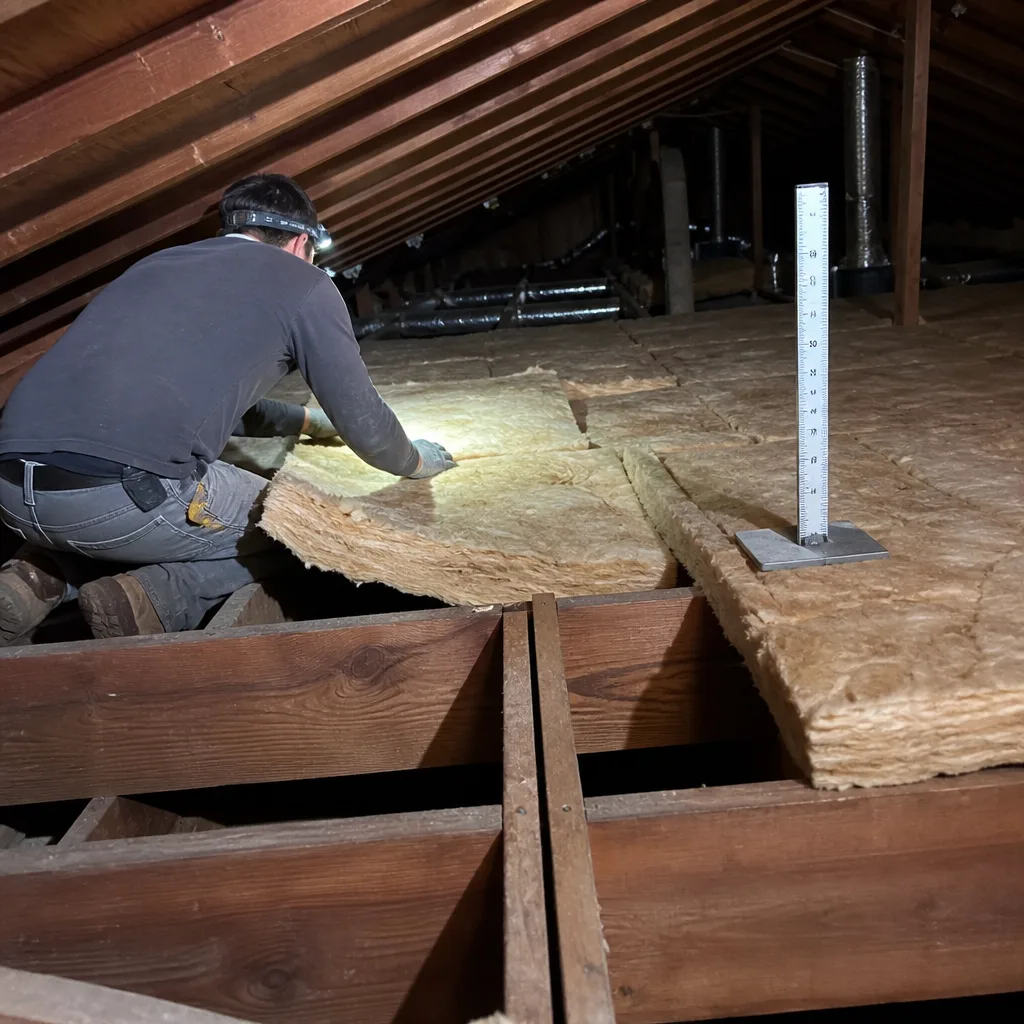
There’s a short list of what a Palo Alto homeowner can safely verify without equipment: measure the existing insulation depth against a yardstick, photograph any bag remnants for product identification, and check the attic access panel for daylight visible around the perimeter. What you cannot safely or accurately do is assess whether the insulation has compressed below its effective R-value, identify active air leaks at electrical penetrations, or distinguish between a product that needs supplementing and one that needs complete removal.
The safety issue specific to attic work: depressurizing a house during air sealing changes the draft on every gas appliance. Wes Okafor runs a combustion-safety check on any gas water heater or furnace in the attic space before the job closes, because we’ve seen flue spillage in Palo Alto homes where the envelope was tightened without verifying the chimney draft. The insulation itself isn’t dangerous to handle with basic PPE, but the building science decisions around it carry real consequences. Seal the leaks first. The insulation has nowhere to work if the air is moving around it. Call (650) 352-3577 for a free estimate and we’ll scope what’s actually happening in your attic.
FAQs
Climate Pro blown-in fiberglass lasts 20-30 years when protected from moisture and undisturbed, though we see effective performance drop after 10-15 years in attics with active air leaks that carry dust and humidity through the material. The Spider system’s adhesive binder begins to degrade around year 12 in unvented attics with temperature swings. Call (650) 352-3577 for a free assessment of your existing installation’s condition.
Only if the existing material is dry, uncompressed, and free of rodent contamination. In Palo Alto, we find that 60% of the attics we inspect have compressed original batts or loose fill with localized water staining from historical roof leaks; adding new material over this traps moisture and masks the problem. We remove and dispose of the old insulation in most cases so we can air seal the deck properly first. Call (650) 352-3577 and we’ll tell you which category your attic falls into.
Most residential retrofits in Palo Alto finish in one day for crews of two technicians, or two days when removal, air sealing, and new installation are all scoped. Jobs with limited access, extensive can light sealing, or mineral wool batts in fire-rated assemblies may extend to a third day. We schedule a specific arrival window, not a callback range. Call (650) 352-3577 to book a date.
We maintain Climate Pro loose fill and TempControl batts on our Palo Alto warehouse shelves; Spider system material ships directly from the regional distributor with a 3-5 day lead time that we absorb into our scheduling. For same-day installation, we need to complete the site assessment and written scope by noon so the crew can load verified materials. Call (650) 352-3577 to confirm current availability for your specific product line.
Written by Wes Okafor, Owner, Topside Attic Insulation Palo Alto at Topside Attic Insulation Palo Alto, serving Palo Alto and nearby areas.