
GreenFiber Attic Insulation: The Palo Alto Owner’s Guide
We stock and install GreenFiber blown-in cellulose attic insulation in Palo Alto, with most complete attic jobs running between $2,800 and $5,400 depending on square footage and whether air sealing is needed first. Same-day installation is available when we have your square footage and access type confirmed by phone. Most Palo Alto homeowners discover their GreenFiber insulation has failed when they notice uneven temperatures between rooms, rising PG&E bills despite mild weather, or find compressed, settled material in the attic that no longer reaches the original R-value marked on their 2015-2020 installation paperwork.
Which GreenFiber Models This Applies To
GreenFiber produces loose-fill cellulose insulation sold under the All Borate and Low Dust product lines, both common in Palo Alto homes built between 1960 and 2005 where owners upgraded attic insulation during the 2015-2020 energy rebate cycles. The All Borate line carries a higher borate fire retardant load and is the version we most often encounter in peninsula jobs. You can identify what you have by checking for a faded GreenFiber bag remnant near the attic hatch, or by the insulation’s gray-brown color and fibrous, almost paper-like texture, distinct from the yellow fiberglass or white mineral wool you might see in newer builds.
GreenFiber cellulose is not model-specific in the way a furnace part would be. What matters for replacement is the settled depth, the current R-value, and whether the original installation included a proper air barrier. We do not use proprietary product lock-ins. GreenFiber cellulose is compatible with standard blown-in application equipment, and we source materials from GreenFiber alongside Owens Corning, Johns Manville, and Knauf so the homeowner chooses the material that fits the assembly, not the contractor’s inventory. If your original installer used GreenFiber Low Dust in a 2×10 joist bay in Old Palo Alto, the replacement needs to hit R-38 minimum per California Title 24, which means 10 to 12 inches of settled depth, not the 8 inches we regularly find compressed after a decade of storage loads and rodent traffic.
Topside Attic Insulation Palo Alto is an independent service provider with no affiliation to GreenFiber.
Signs Your GreenFiber Attic Insulation Is Failing
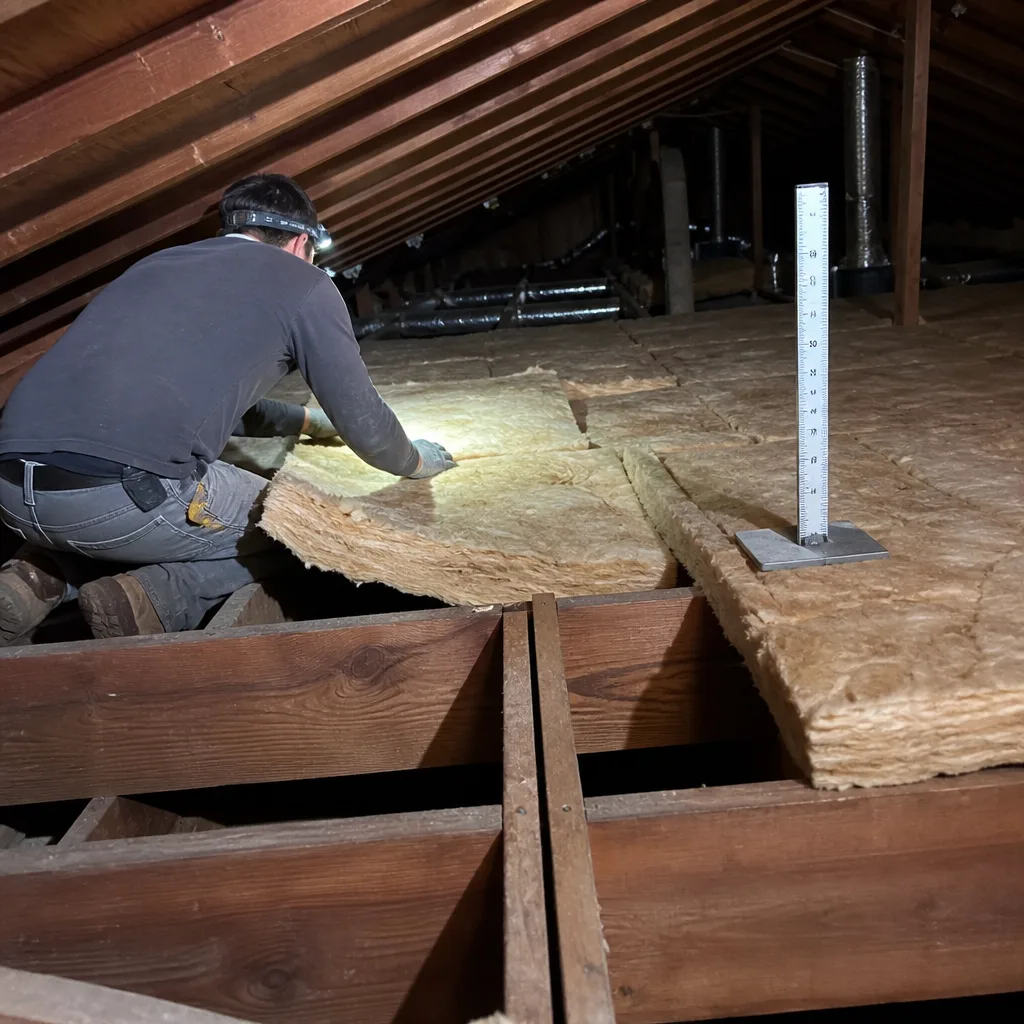
- Uneven room temperatures upstairs. Cellulose settles 20% over its first two years, and in Palo Alto’s older ranch homes near Midtown we’ve measured original 12-inch depths compressed to 6 inches after homeowners used the attic for storage. The thermal resistance drops proportionally, so the room below the thin spot overheats in August and chills in January.
- Spikes in heating and cooling costs without rate changes. When GreenFiber loses loft, the attic floor assembly performs closer to R-19 than the intended R-38. Your HVAC runs longer to compensate. We see this most often in homes where the original installer skipped top-plate sealing and the stack effect, warm air rising and pulling cold air in at the base of the house, has been grinding the material down with convective air movement for years.
- Visible mold or musty odor after winter rains. Cellulose is treated with borate for fire resistance, but it is still paper-based. If the roof leaked or bathroom vents dump moist air into the attic, GreenFiber will wick and hold moisture. In Palo Alto’s microclimate, where marine layer moisture lingers longer than inland valleys, this happens faster than owners expect.
- Rodent nesting material mixed with gray-brown fibers. Cellulose is attractive to roof rats and mice once they breach the envelope. We find shredded GreenFiber packed into soffits and eaves regularly, particularly in Barron Park and the neighborhoods south of Oregon Expressway where mature tree canopy gives rodents highway access.
- Dust or particulate settling through recessed can lights. This signals both failed insulation and failed air sealing. GreenFiber particles are heavier than fiberglass, but without a sealed top plate and properly baffled fixtures, any loose-fill material will migrate into conditioned space under pressure differential.
Replacement Cost & What’s Included
Most GreenFiber attic insulation replacements in Palo Alto run between $2,800 and $5,400 for a complete removal and reinstall, with the lower end covering 800-1,000 square feet of straightforward access and the upper end including extensive air sealing, rodent soiled material removal, and rebuilt access panels. The price breaks down as removal and disposal at $1.20 to $1.80 per square foot, new material and installation at $1.50 to $2.40 per square foot, and air sealing of top plates, can lights, and penetrations at $400 to $900 depending on the home’s complexity.
What drives the range: attic height (steep cathedral ceilings cost more), existing material condition (rodent-soiled cellulose requires full PPE removal and HEPA containment), and whether the job includes our standard blower-door test. We publish before-and-after blower-door numbers on every applicable job, a pressurization reading that shows, in one figure, how much conditioned air the home was losing before and after the work. Under Haven Standard Clause 1, you get a flat written price, a written scope, and a written warranty before anyone lifts a tool. The 365-Day Done Right Promise applies to all completed work.
DIY or Call Us?
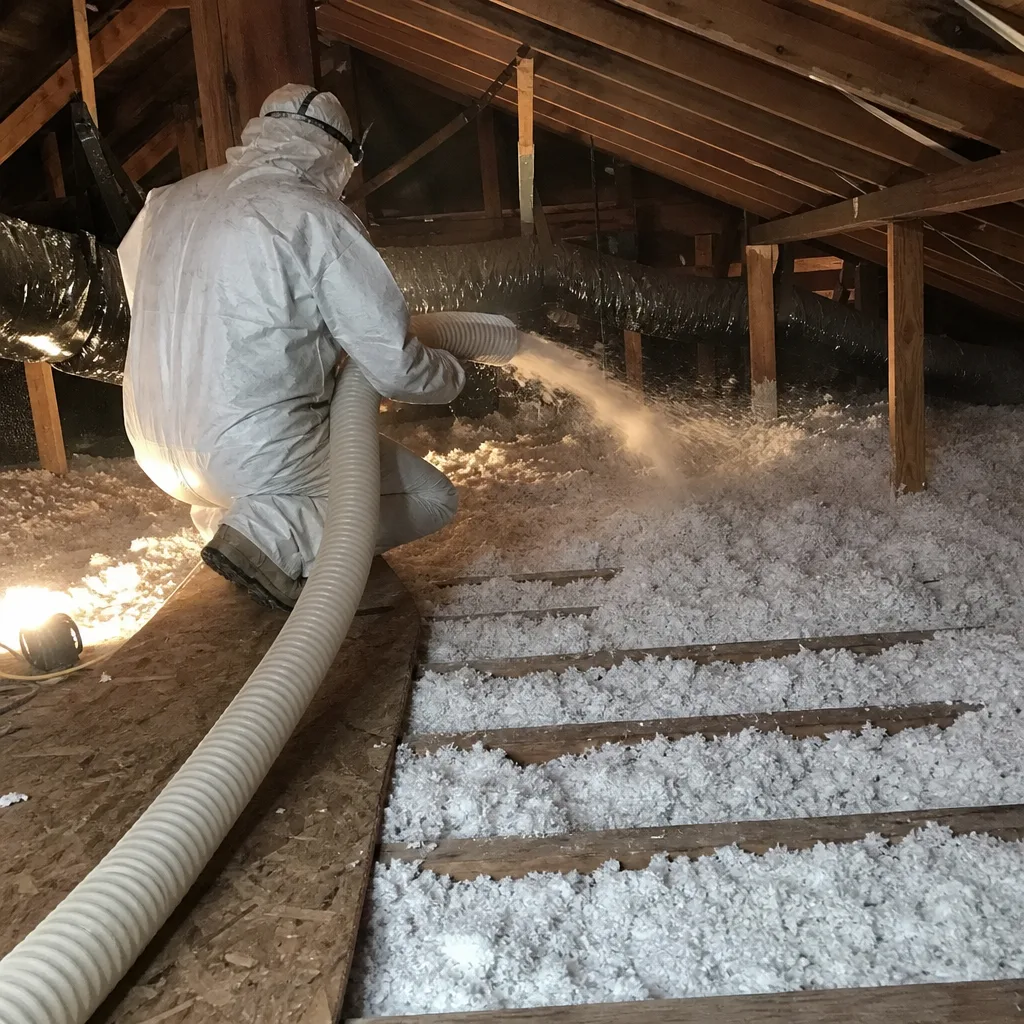
There is no high-tension or electrical danger in handling cellulose insulation, but there are real reasons most Palo Alto homeowners stop after the inspection phase. Removal of settled GreenFiber requires a commercial-grade HEPA vacuum and proper respirators, not a shop vac and a dust mask. The material compacts in wall cavities and joist bays in ways that look simple to rake out but take hours without the right equipment. More critically, most GreenFiber failures we see trace back to air leaks that were never sealed in the first place. Adding new insulation over an unsealed attic floor is how you get the same failure twice.
What you can safely check: measure your current insulation depth with a ruler at three points, photograph any discoloration or rodent activity, and verify your bathroom vents terminate outside, not into the attic space. What we handle: the removal, the combustion-safety check on any gas appliance in the attic before we depressurize the house, the top-plate sealing with foam and caulk, and the documented photo record you receive at job close. Seal the leaks first. The insulation has nowhere to work if the air is moving around it. Call (650) 352-3577 when you’re ready for a written price.
FAQs
GreenFiber cellulose has a stated lifespan of 20 to 30 years, but in Palo Alto’s specific conditions we see functional performance drop closer to 10 to 15 years when air sealing was skipped or the attic was used for storage. The marine layer moisture and the peninsula’s temperature swings accelerate settling and compression. Call (650) 352-3577 for a depth inspection and free estimate.
Spot repairs are possible if the failure is isolated to one bay or a small rodent-damaged area, but in most cases we recommend full removal and replacement. Compressed or moisture-compromised cellulose cannot be refluffed to original R-value, and partial replacement creates thermal bridges at the seams. We stock GreenFiber-compatible cellulose on our trucks and can match or upgrade your assembly. Call (650) 352-3577 for an exact scope and written price.
A standard 1,200-square-foot attic removal and replacement takes one full day, or two days if extensive air sealing and a blower-door test are included. We arrive with a named technician, send a text when we’re on the way under Haven Standard: Arrive on schedule, and you receive the Documented Photo Record before we leave. Same-day starts are available for straightforward jobs confirmed by morning.
We stock GreenFiber All Borate and Low Dust cellulose on our trucks, alongside Owens Corning, Johns Manville, Knauf, and Rockwool, so there is no material delay for standard Palo Alto jobs. We source from the same distribution network that supplies the region’s contractors, with no proprietary lock-in. If your HOA or rebate program requires a specific product, we confirm compatibility before the written price is issued. Call (650) 352-3577 to check truck stock for your square footage.
Ready to fix your attic? Call (650) 352-3577 for a free estimate with a written price before any work starts. Our live answering is available 24/7, and we serve Palo Alto and nearby peninsula cities with background-checked, uniformed technicians who arrive on schedule and leave you with documented proof of the work performed.
Written by Wes Okafor, Owner, Topside Attic Insulation Palo Alto at Topside Attic Insulation Palo Alto, serving Palo Alto and nearby areas.