
Knauf Vapor Barrier Installation: The Palo Alto Owner’s Guide
Knauf vapor barrier installation in Palo Alto typically runs $1,800-$3,400 for a complete crawl space encapsulation, with most single-story homes in the $2,200-$2,800 range. We stock Knauf Insulation’s Faced Batt and EcoSeal-compatible vapor barrier systems on our trucks, and we can usually inspect and quote same-day if you call before noon. Most owners discover the problem when they notice a musty smell coming up through the floorboards or their energy auditor flags elevated moisture readings in the crawl space during a routine inspection.
Which Knauf Models This Applies To
Knauf manufactures vapor barrier materials across several product lines, and matching the right system to your existing insulation matters more than most contractors admit. We regularly work with Knauf’s Faced Batt insulation, which ships with a kraft paper or foil-facing vapor retarder attached to the batt itself, and their unfaced batts paired with separate polyethylene sheeting for crawl space floors and walls. The facing should be printed with “Knauf Insulation” and an ASTM C665 type designation; if you’re reading this because the facing is delaminating or the poly sheeting has torn at the seams, we need to know whether your original install used 6-mil poly, 10-mil reinforced, or Knauf’s newer cross-laminated product.
Here’s where owners get tripped up: Knauf’s Faced Batt is rated as a Class II vapor retarder, which is appropriate for Palo Alto’s mixed-humid climate zone, but only if the facing is installed toward the conditioned space. We find it reversed in about one in four attics we inspect, especially in ranch homes built between 1955 and 1975 near Midtown Palo Alto where the original contractor apparently worked by flashlight. For crawl spaces, we prefer Knauf’s unfaced EcoSeal system with a separate ground vapor barrier because it lets us seal the rim joist and sill plate with acoustic sealant before the barrier goes in. That’s the OEM approach. Some competitors substitute generic 6-mil poly from the hardware store; it costs less upfront, but the seams fail faster and the warranty is usually void if Knauf’s system was specified in the original scope.
Topside Attic Insulation Palo Alto is an independent service provider, not affiliated with Knauf. We source Knauf materials through standard distribution channels and can also install Reflectix radiant barrier products where the assembly calls for them.
Signs Your Knauf Vapor Barrier Installation Is Failing
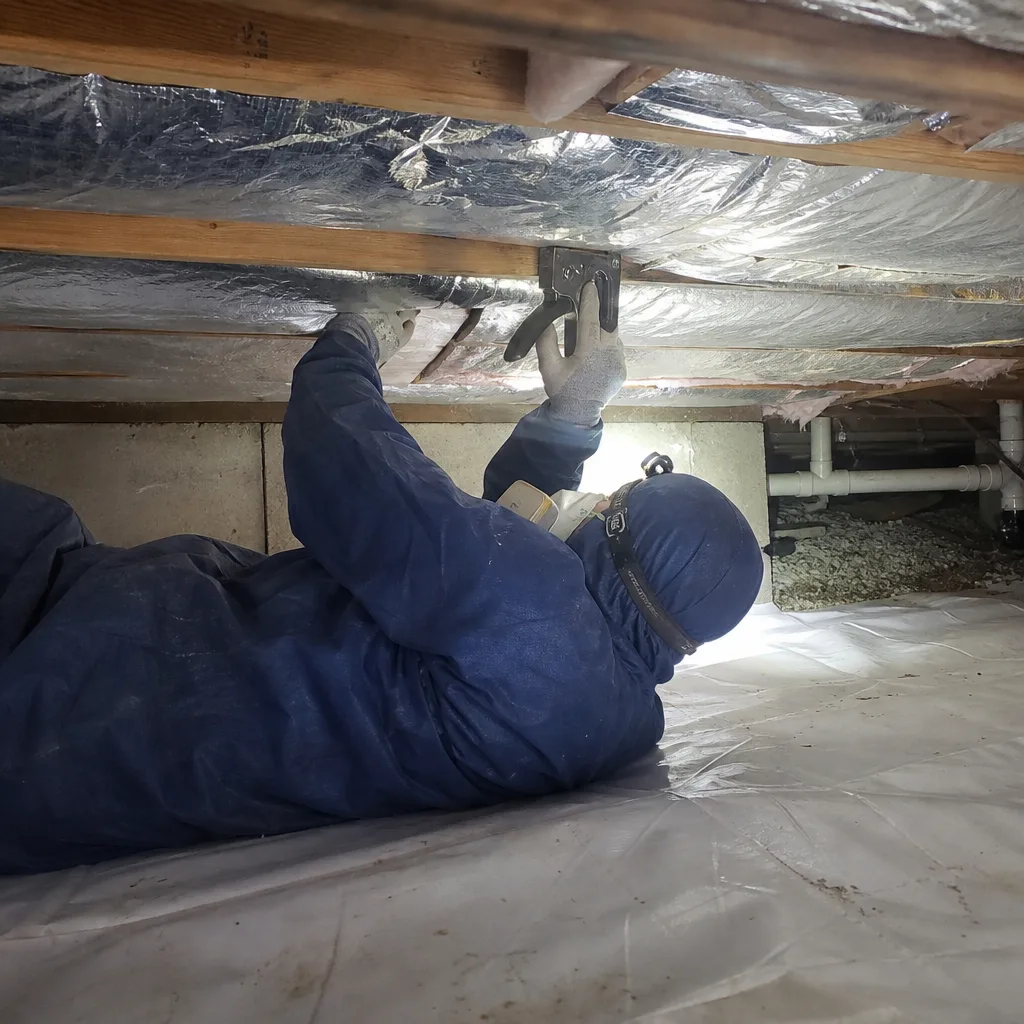
- Musty odors rising through floor registers. When the vapor barrier tears at seams or pulls away from the foundation wall, soil moisture evaporates directly into the crawl space air. That humid air gets drawn upward by stack effect, the buoyancy of warm air rising and pulling replacement air in at the base of the house, and it carries the smell of damp earth with it. We smell this most often in Palo Alto homes with original Redwood City soil conditions, where the clay holds moisture longer than owners expect.
- Condensation on ductwork or plumbing lines in the crawl space. A compromised barrier raises the dew point of the air surrounding cold surfaces. When the relative humidity climbs above 60 percent, you’ll see beads on copper lines and galvanized ductwork that wasn’t insulated separately. Left alone, this is how we get the phone call about a rusted-out furnace cabinet.
- Wood floor cupping or laminate warping. Moisture migrating through a failed barrier gets trapped between the subfloor and finished flooring. Oak and maple show it first, with boards crowning in the center of the room. We’ve traced this pattern back to a single unsealed seam in the vapor barrier more times than I can count.
- Insulation sagging or falling from crawl space joist bays. Knauf’s Faced Batt relies on friction and staple attachment; when the facing absorbs moisture because the ground barrier below it has failed, the paper delaminates and the batt drops. You’ll see this as gray or yellow material on the ground, not in the joist bay where it belongs.
- Mold or mildew on the crawl space perimeter walls. This usually means the vapor barrier terminates short of the wall or wasn’t sealed to it with proper mastic. Knauf’s installation guidelines call for a 6-inch overlap and mechanical fastening; we use acoustic sealant at the wall joint because Palo Alto’s seasonal groundwater fluctuation will find any gap.
Replacement Cost & What’s Included
| Scope | Typical Range in Palo Alto |
|---|---|
| Partial repair (seam re-sealing, localized replacement) | $650-$1,200 |
| Full crawl space vapor barrier replacement, single-story | $1,800-$2,800 |
| Full replacement with rim joist air sealing | $2,400-$3,400 |
| Two-story or conditioned crawl space with dehumidifier | $3,200-$4,500 |
The price range depends on three things we measure during our initial inspection: the square footage of the crawl space, the condition of the existing barrier (whether we can salvage sections or need complete removal), and whether the rim joist and sill plate have been air-sealed. We never blow insulation over an unsealed attic floor, and we apply the same principle downstairs: seal the leaks first. The insulation has nowhere to work if the air is moving around it.
Every vapor barrier job includes removal and responsible disposal of the failed material, installation of new Knauf-compatible barrier with sealed seams and wall terminations, and a Documented Photo Record showing before, during, and after. If we scope a blower-door test, you’ll get the pre- and post-sealing CFM50 readings in your written report. Under Haven Standard Clause 1, you get a flat written price before anyone lifts a tool, and the 365-Day Done Right Promise covers the installation.
DIY or Call Us?
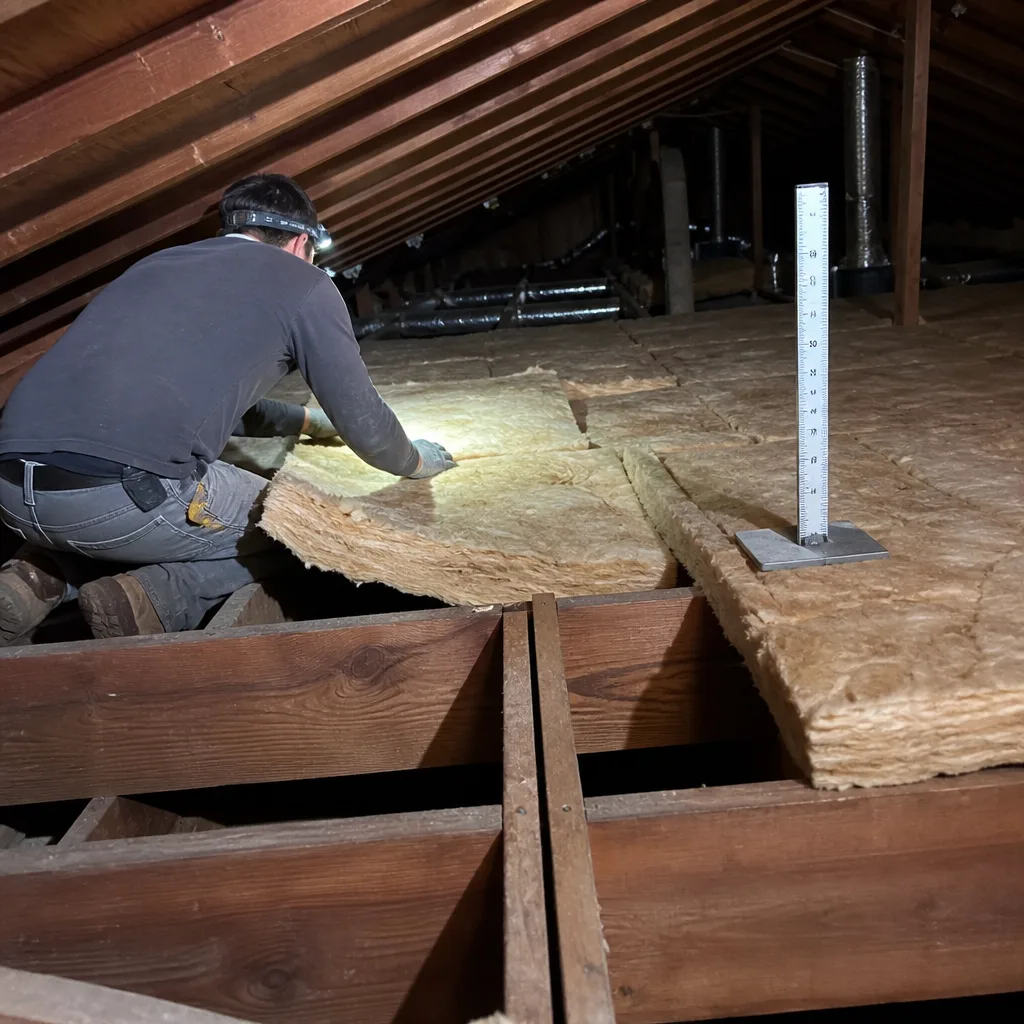
There’s no high-tension danger in vapor barrier work, but there is a lot of ways to waste money. A homeowner can safely inspect their own crawl space with a flashlight and a respirator rated for mold spores, looking for the symptoms we listed above. You can also verify the facing direction in your attic by checking whether the printed side faces the living space below.
Where DIY goes wrong is in the prep. Pulling out old barrier without addressing the moisture source first just means the new barrier fails the same way. Seaming poly sheeting with duct tape instead of vapor-barrier-specific tape creates channels for soil gas and humidity. And most homeowners don’t own a blower door to verify whether their rim joist sealing actually worked. We’ve been called in to remove a homeowner’s second attempt more than once. If you’ve already got a written estimate from another contractor, bring it to us; our Free Second Opinion means we’ll read it with you and tell you where the scope looks thin. Call (650) 352-3577 when you’re ready to have it done once.
FAQs
Properly installed Knauf vapor barrier systems last 15-25 years in Palo Alto’s climate, though we’ve replaced 8-year-old installs where the original contractor used 4-mil poly instead of the specified 6-mil or where groundwater drainage was never addressed. The clay soils common in older Palo Alto neighborhoods, particularly around Professorville and the areas north of Oregon Expressway, hold moisture against the foundation longer than the sandy loam in newer developments, which shortens lifespan if the grade isn’t sloped away from the house. Call (650) 352-3577 for an inspection if you’re unsure of your install date; estimates are free.
Small punctures and seam separations under three linear feet can be patched with vapor-barrier tape and still perform, but widespread embrittlement, delamination of facing from batts, or multiple tears mean replacement. We assess this during our inspection and will show you the photos so you can see what we see. If replacement is necessary, we’ll give you a written price before any work starts. Call (650) 352-3577 to schedule.
Most single-story crawl spaces in Palo Alto take one day, with the crew arriving around 8 a.m. and finishing by late afternoon. Two-story homes or conditioned crawl spaces with dehumidifier integration may run into a second day. We text you when the technician is on the way, and you get the Documented Photo Record and written report by email that evening. Call (650) 352-3577 to check same-day availability.
Yes. We carry 6-mil and 10-mil reinforced polyethylene sheeting, Knauf-compatible vapor-barrier tape, acoustic sealant for rim joist work, and unfaced batts for joist bay replacement. For specialized Knauf orders or Reflectix radiant barrier assemblies, we can usually have materials on-site within 24 hours. We don’t start the job until you’ve approved the written scope and price. Call (650) 352-3577 to confirm current stock for your specific model.
Written by Wes Okafor, Owner, Topside Attic Insulation Palo Alto at Topside Attic Insulation Palo Alto, serving Palo Alto and nearby areas.