
How Much Does Radiant Barrier Installation Cost in Palo Alto?
Radiant Barrier Installation services in Palo Alto, CA typically cost between $1,400 and $3,200 for a standard single-story home, with most jobs in the 1,500-2,500 sq ft range landing around $1,800 to $2,400. That price covers material and labor for a foil radiant barrier stapled to the underside of the roof rafters or laid over attic floor insulation, and it reflects current Bay Area labor rates as of 2026. A written price, flat-quoted before any work starts, is how every job at Envelope Insulation Co. begins – no estimates that balloon after the crew arrives.
Radiant Barrier Installation Cost Breakdown (2026)
Radiant barrier cost in Palo Alto, CA breaks down across three levers: square footage of attic coverage, the type of barrier product used, and the installation method. The table below reflects current 2026 market pricing for homes in Palo Alto and the surrounding areas – Professorville, Crescent Park, Midtown, and the College Terrace neighborhoods where 1950s-1970s ranches and two-story colonials make up a large share of our jobs.
| Scope / Scenario | Typical Price Range (2026) | Notes |
|---|---|---|
| Small attic (under 1,200 sq ft) | $950 - $1,500 | Common in bungalows and townhomes near downtown Palo Alto |
| Standard single-story (1,200-2,000 sq ft attic) | $1,400 - $2,400 | Most common job size in Palo Alto |
| Larger home (2,000-3,000 sq ft attic) | $2,200 - $3,200 | Two-story homes, sprawling Eichlers in nearby areas |
| Rafter-staple method (premium install) | Add $150 - $350 | Requires more labor; better airflow gap maintenance |
| Attic floor lay-over method | Included in base price | Faster install; paired with existing blown-in insulation |
| Perforated foil (standard product) | $0.18 - $0.28 per sq ft material | Allows moisture vapor transmission; preferred in Palo Alto’s Mediterranean climate |
| Multi-layer reflective barrier (premium product) | $0.45 - $0.75 per sq ft material | Higher R-value equivalent; used in attics with limited depth |
| Air sealing prior to barrier (recommended) | $350 - $900 additional | Top plates, can lights, penetrations sealed before barrier goes in |
| Combined radiant barrier + attic insulation upgrade | $2,800 - $5,500 | Full envelope treatment; qualifies for PG&E rebates in many cases |
Labor in the South Bay and Peninsula runs higher than inland markets. A radiant barrier job that costs $1,100 in Fresno will routinely cost $1,600-$1,900 in Palo Alto for the same square footage – Bay Area crew rates and overhead account for most of that gap. Material costs are relatively stable across the state, so the delta is almost entirely labor.
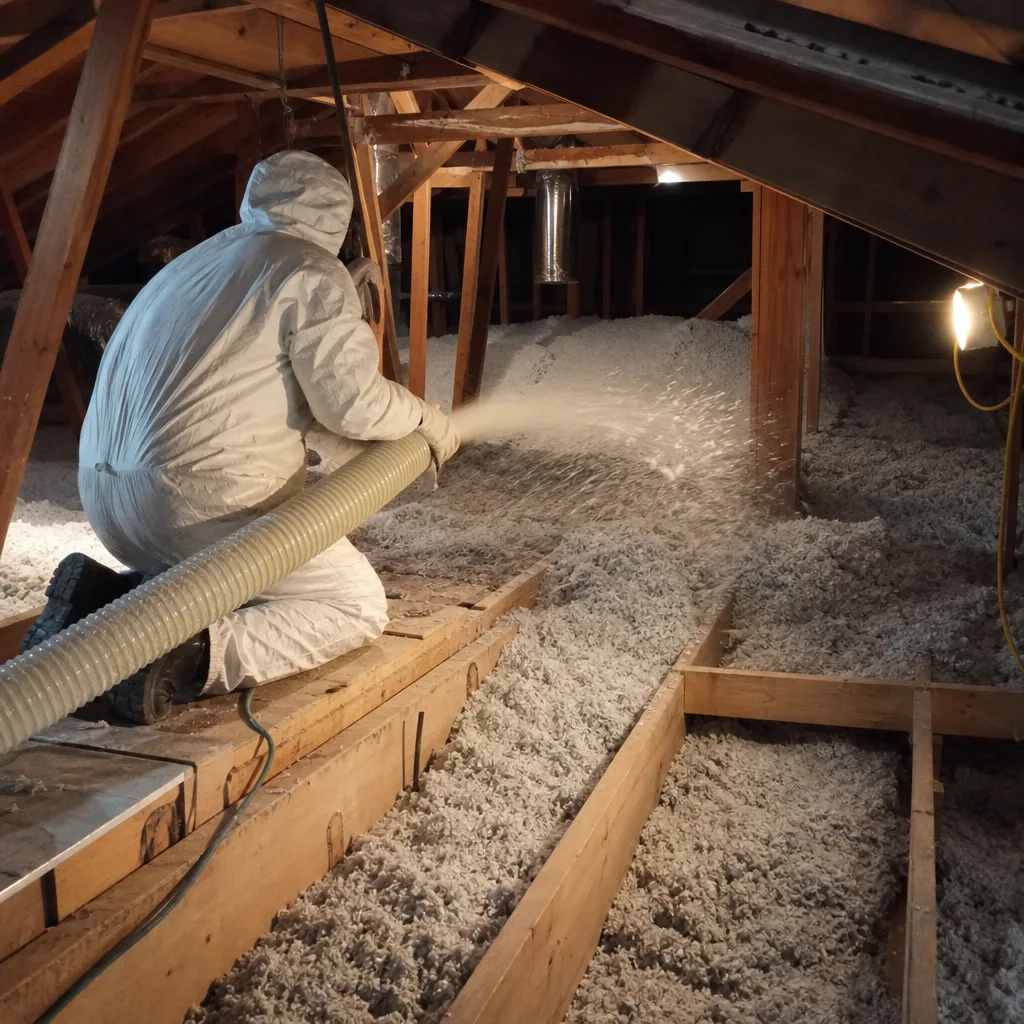
One thing that consistently affects the final number: attic condition. Palo Alto homes built before 1980 often have compressed or deteriorated existing insulation, active knob-and-tube wiring in older sections of Professorville, or blocked soffit vents that need clearing before a radiant barrier performs the way it should. We photograph every attic before and after, so you can see exactly what we found and what changed.
What Affects Radiant Barrier Installation Pricing in Palo Alto
- Attic square footage and geometry: Price scales with coverage area, but geometry matters as much as size. A 1,800 sq ft attic with a simple gable roof is faster to work in than a 1,400 sq ft attic cut up by dormers, HVAC equipment, and multiple valleys – the latter can cost as much or more because of the time spent cutting, fitting, and taping around obstacles. Many Palo Alto homes in the Crescent Park and Old Palo Alto neighborhoods have complex rooflines that add 15-25% to labor time.
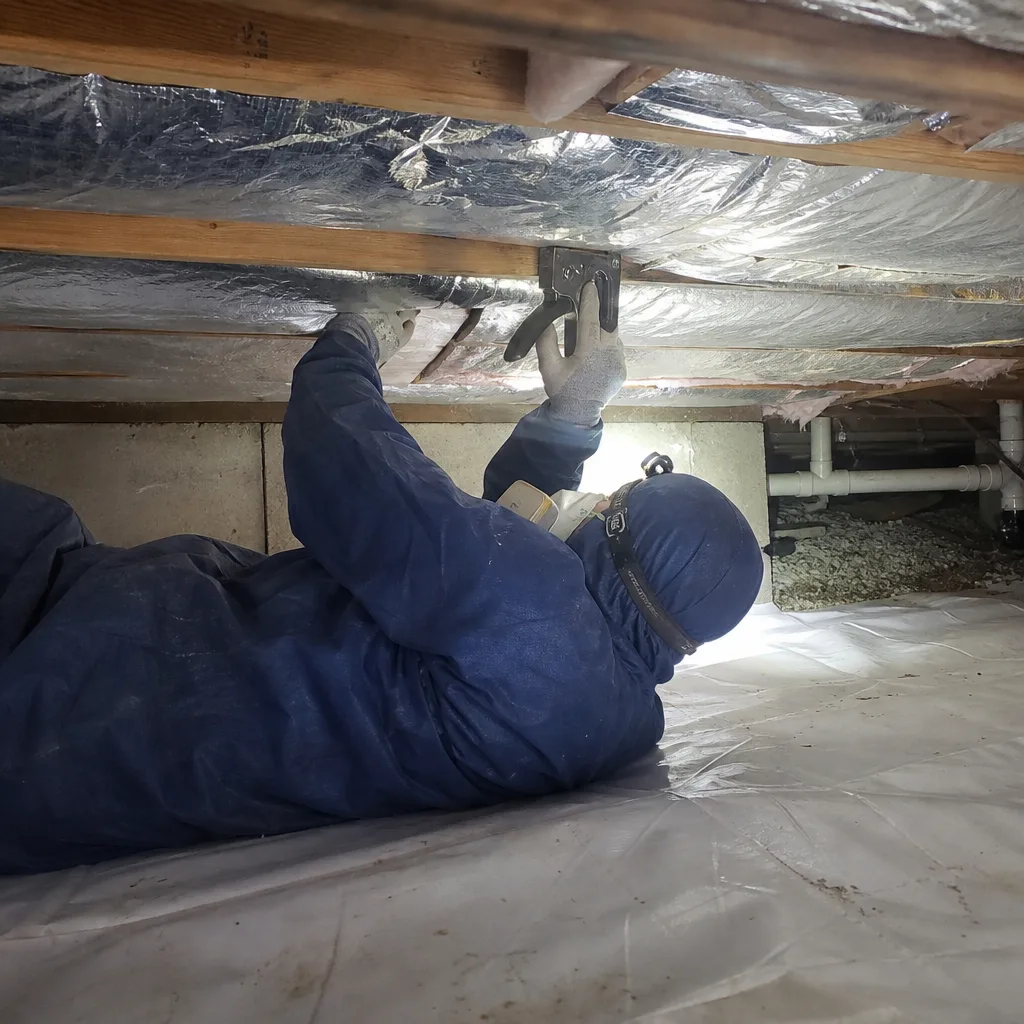
- Installation method: Stapling the barrier to the underside of rafters – the rafter-drape method – requires the installer to work at rafter height across the entire roof deck and maintain a specific air gap between foil and roof sheathing. It takes longer than laying barrier material over the attic floor, but it’s the correct approach for a tile or composition shingle roof where roof-deck temperatures can exceed 150°F on a Palo Alto summer afternoon. That temperature differential is exactly what a radiant barrier is designed to reflect back out.
- Attic access difficulty: Standard attic access through a pull-down stair is priced into the base quote. A flat-ceiling attic with a single 22×30-inch hatch and no flooring – common in 1960s Eichler-adjacent construction throughout the area – adds crew time for material staging and mobility. Jobs in South Palo Alto homes with low-pitched roofs and 18-inch clearance at the eaves regularly take 30-40% longer than a comparable square footage in a steep-pitch attic.
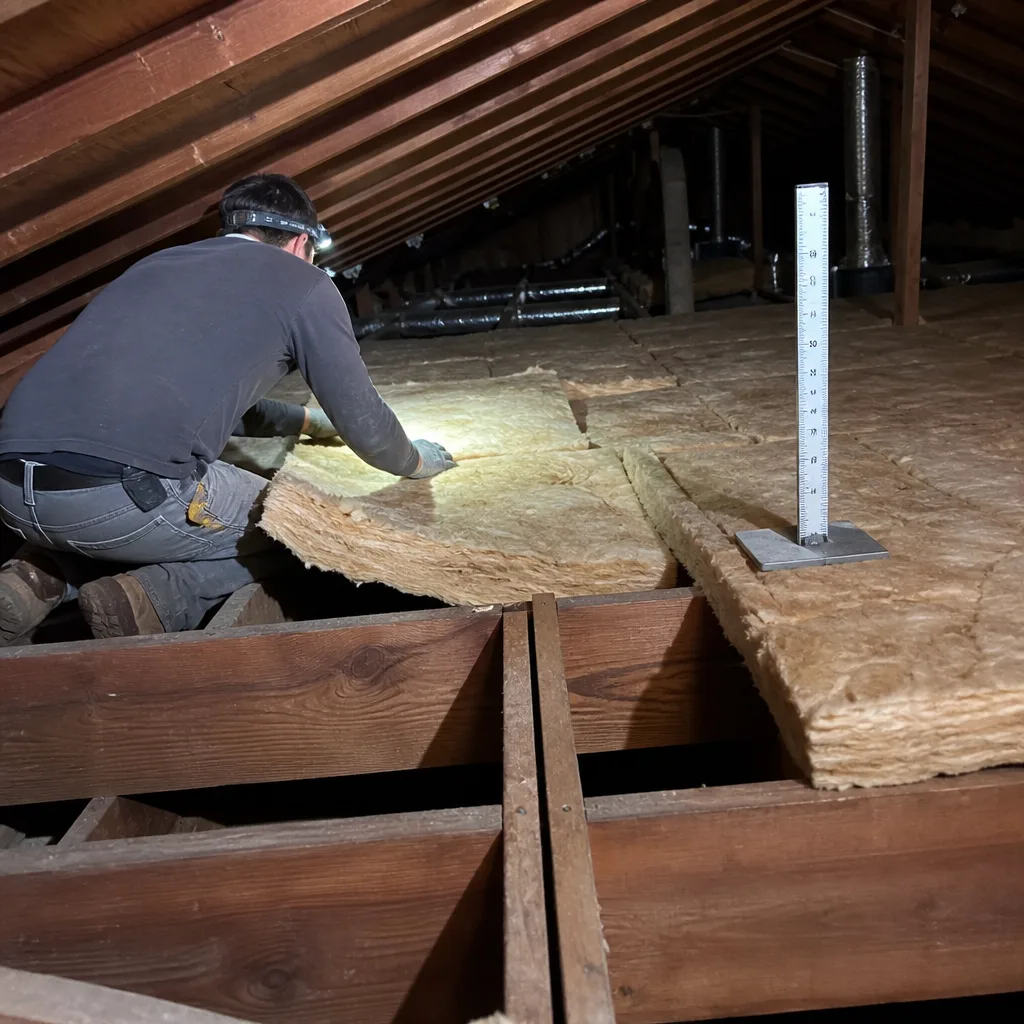
- Existing insulation depth and condition: If your attic has less than R-19 of existing insulation, installing a radiant barrier alone won’t solve the comfort problem. Palo Alto’s climate – Zone 3C under California’s Title 24 code – calls for R-38 minimum in attic floors for new construction. Homes in the Barron Park neighborhood built in the early 1970s frequently turn up with R-11 batts that have settled to effective R-7. Addressing the insulation layer properly, before or alongside the barrier, changes the project scope and cost but also changes the outcome.
- Air sealing scope: At Envelope Insulation Co., air sealing of top plates, recessed can lights, and attic penetrations is treated as a prerequisite, not an optional add-on. We will not install a radiant barrier over an attic floor that hasn’t been air-sealed, because conditioned air escaping through unsealed top plates will undermine whatever the barrier reflects. The air sealing cost – typically $350 to $900 in Palo Alto depending on penetration count – is quoted separately and explicitly so you can see exactly what you’re paying for each scope item.
- Permit requirements: Radiant barrier installation as a standalone job does not currently require a permit from the City of Palo Alto Building Department in most residential applications. However, if the project includes electrical work to address knob-and-tube wiring (which must be addressed before insulation in pre-1940 homes) or HVAC duct sealing under the same scope, permit requirements apply. We identify these conditions during the pre-job walkthrough and quote accordingly – nothing surfaces as a surprise after the work is priced.
Does Palo Alto’s Climate Actually Justify a Radiant Barrier?
This is a fair question, and the honest answer is: yes, for cooling load – and the math is tighter than most homeowners expect.
Palo Alto sits in ASHRAE Climate Zone 3C, which is classified as warm-marine. Summers are dry and warm rather than brutally hot, and the coastal influence keeps overnight lows mild. That profile leads some people to assume a radiant barrier is less important here than in, say, Sacramento or Fresno. But the relevant metric is peak roof-deck temperature, not average summer temperature.
On a clear July afternoon in Palo Alto, a dark composition shingle roof will reach 140-160°F at the surface. The underside of that roof deck radiates heat downward into the attic space, raising attic air temperature well above outside ambient – often to 130-145°F. Your HVAC ducts, if they run through that attic (and in most homes built before 2005, they do), are working inside a space that’s 50-60°F hotter than the outdoor air. A radiant barrier with a proper air gap reflects 95-97% of that radiant heat before it reaches the attic air, which measurably reduces the load on duct-distributed air conditioning and, in homes without central AC, reduces the thermal mass the building has to shed overnight.
The Midtown and College Terrace neighborhoods, where a lot of 1960s-1970s two-story construction sits on tight lots with limited shading, see the most consistent benefit. Homes in Old Palo Alto with mature tree canopy over the roof see a somewhat smaller gain because radiant heat is already being intercepted before it hits the shingles.
We measure attic temperature differentials before and after on jobs where the customer wants the data. On a representative two-story home in Palo Alto last July, attic temperature 18 inches above the floor measured 138°F at 2:30 pm before barrier installation. Forty-eight hours after install, same time of day, same weather conditions: 104°F. That’s not marketing language – that’s a thermocouple reading logged in the job record, which you receive as part of the Documented Photo Record when the crew leaves.
PG&E Rebates and California Energy Incentives for Radiant Barriers
As of 2026, PG&E’s residential energy efficiency rebate program covers radiant barrier installation when it is part of a qualifying whole-home insulation upgrade. A standalone radiant barrier installation does not currently qualify for a direct PG&E rebate, but when combined with an attic insulation upgrade to meet Title 24 minimum levels, the combined project can qualify under the Home Upgrade program for rebates ranging from $250 to $1,000 depending on the measures installed and the home’s baseline condition.
The California Energy Commission’s Title 24 compliance path also affects new construction and major renovation projects in Palo Alto – radiant barriers are listed as a compliance credit for roof assembly performance in Climate Zone 3. If you are pulling a building permit for an addition or re-roof in Palo Alto, a radiant barrier can offset some of the required roof insulation R-value under the prescriptive compliance path.
Federal tax credits under the Inflation Reduction Act’s 25C provision cover insulation and air sealing but do not currently list standalone radiant barriers as a qualifying measure. A project that includes both radiant barrier and qualifying air sealing may allow the air sealing portion to be claimed. We document every line item of scope separately for exactly this reason – so your tax preparer can make the call on what qualifies rather than guessing from a single invoice total.
How to Save on Radiant Barrier Installation in Palo Alto
The single most effective way to reduce your net cost is to combine the radiant barrier with an insulation upgrade you may already need. Palo Alto homes built before 1985 that haven’t had their attic insulation touched are often sitting at R-11 to R-19 in the attic floor – well below the R-38 that Title 24 calls for and below what delivers meaningful comfort in a Palo Alto summer. Doing both in one crew visit eliminates duplicate mobilization costs (typically $150-$300 per trip for a Bay Area crew), and the combined project qualifies for PG&E rebates that a barrier-only job doesn’t.
A few other concrete ways to keep the number down:
- Clear the attic access path before the crew arrives. Garage attic hatches blocked by stored items or pull-down stairs that haven’t been used in years add crew time that shows up in the labor line. Twenty minutes of clearing your own attic access can save you 30-45 minutes of billable time.
- Address duct sealing at the same time. If your HVAC ducts in the attic are poorly connected or uninsulated, adding mastic sealant and duct wrap during the same project visit is more efficient than a separate trip. We quote duct work as a separate line item so you can decide, but the labor savings from combining are real.
- Get a free second opinion on any written estimate you already have. Under the Haven Standard, we will read a competing quote with you line by line. If another contractor has priced a scope that doesn’t include air sealing, or has priced a vapor-impermeable foil in an attic that needs perforated material for Palo Alto’s climate, we’ll point that out – not to win the job on price, but because an incorrect installation choice costs more to fix later than to get right the first time.
- Ask about timing. Late fall and winter are slower months for attic work across the Peninsula. Crew availability is higher, and scheduling flexibility tends to be better – which doesn’t mean discounted rates, but it does mean you’re less likely to wait two weeks for an installation date when your attic temperature is already dropping for the season.
- Request a home energy audit first. A home energy audit – a blower-door test combined with thermal imaging – will tell you whether a radiant barrier is your highest-priority thermal improvement or whether air sealing alone will deliver the bigger return per dollar. Some Palo Alto homes are losing more conditioned air through unsealed top plates than they’re losing through radiant heat gain. Spending $1,800 on a barrier when $900 in air sealing would have solved 80% of the problem is not a win.
To get a written price for your specific attic, call (650) 352-3577. The estimate is free, the price is flat and written before any work starts, and there’s no obligation to proceed.
Radiant Barrier vs. Additional Attic Insulation: Which Should You Do First in Palo Alto?
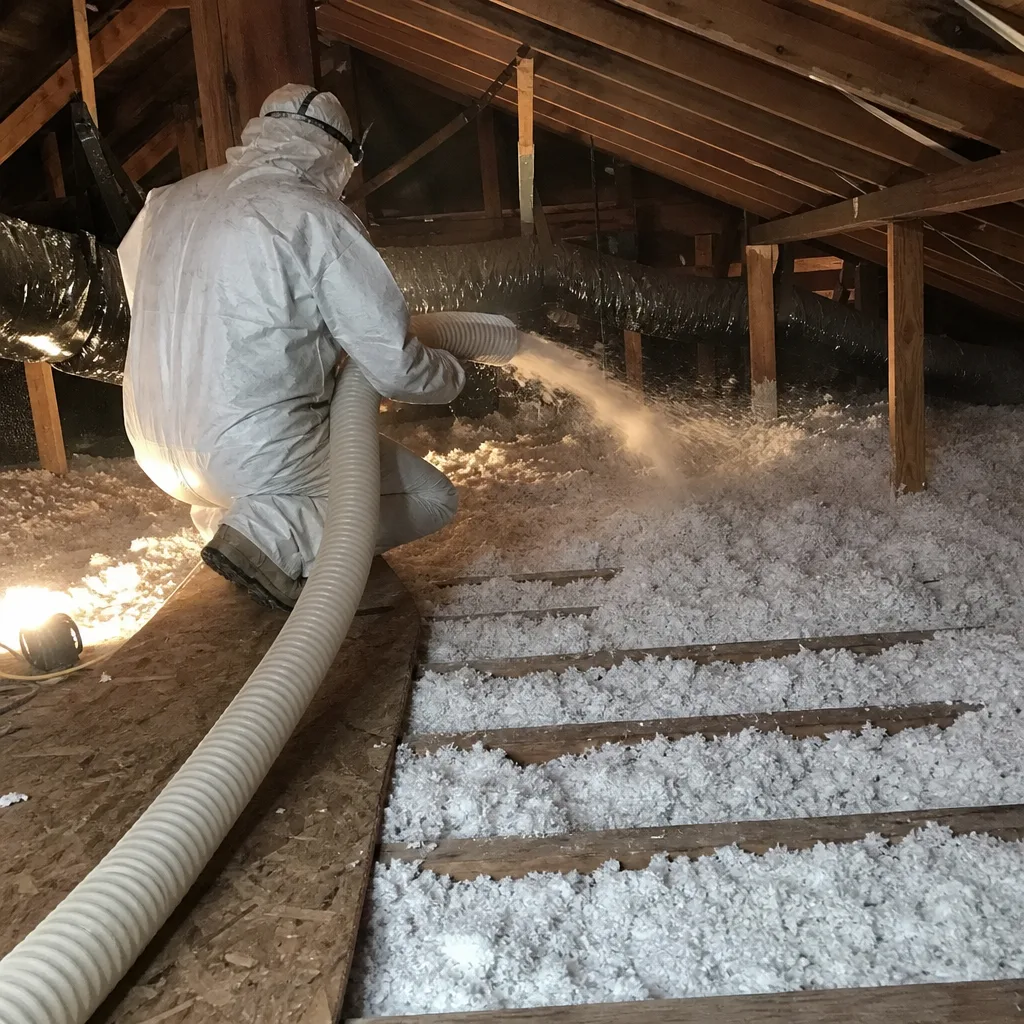
If your attic currently has less than R-30 of insulation, adding insulation to reach R-38 or R-49 will almost always deliver a larger year-round energy return than a radiant barrier alone. Insulation addresses both heating and cooling loads – and Palo Alto winters, while mild by most standards, do pull heat out of under-insulated homes at a consistent rate from November through March. A radiant barrier only works against radiant heat gain and provides essentially no benefit to winter heating performance.
The correct sequence – and the one we follow on every job – is: air seal first, then insulate to target R-value, then add a radiant barrier if the roof geometry and cooling load justify it. Installing a radiant barrier over compressed, insufficient insulation is a waste of money because the insulation layer itself is still failing to resist conductive heat flow from the attic air into the conditioned space.
For a home in Palo Alto’s Barron Park neighborhood with R-11 batts and a south-facing roof, the budget math usually works out to: $900 in air sealing, $1,200-$1,600 in blown-in insulation to reach R-38, and $1,400-$1,800 for the radiant barrier – for a total of $3,500-$4,300 that addresses all three failure modes at once. Done in sequence, in one project, with one written price. That’s the Radiant Barrier Installation in Palo Alto approach we take: envelope-first, documented throughout.
FAQs – Radiant Barrier Installation Cost in Palo Alto
How much does radiant barrier installation cost in Palo Alto in 2026?
Most radiant barrier installation jobs in Palo Alto run between $1,400 and $3,200 depending on attic square footage, roof geometry, and whether air sealing is included. A standard single-story home with 1,500-2,000 sq ft of attic space typically lands between $1,800 and $2,400 with labor and materials included. Call (650) 352-3577 for a written, flat-rate quote at no charge – the price you get before work starts is the price you pay.
Is a radiant barrier worth it for a Palo Alto home?
For most Palo Alto homes with duct systems running through the attic, yes – particularly homes built before 2000 where the ducts are not encapsulated in conditioned space. Roof-deck temperatures in Palo Alto regularly exceed 140°F on summer afternoons, and attic air temperatures follow. On a recent job in Palo Alto’s Midtown neighborhood, attic air temperature dropped from 138°F to 104°F at peak afternoon heat after barrier installation. The payback period on a correctly installed barrier in a home with central air conditioning is typically 4-7 years in this market, shorter if PG&E rates continue their current trajectory.
Does Palo Alto require a permit for radiant barrier installation?
A standalone radiant barrier installation in an existing home does not typically require a permit from the City of Palo Alto Building Department. Exceptions apply if the project disturbs knob-and-tube wiring, requires electrical modifications, or is part of a larger permitted scope. We assess permit requirements during the pre-job walkthrough and include any required permit costs in the written price – they never surface as a line item after the fact.
How long does radiant barrier installation take in a Palo Alto home?
Most single-story homes in Palo Alto are completed in 4-8 hours with a two-person crew. A larger two-story home or a complex roofline – common in Old Palo Alto and Crescent Park – runs 6-10 hours. Attics with existing HVAC equipment, multiple valleys, or low clearance at the eaves take longer; we account for this during the estimate rather than adjusting the price on the day of installation.
Can I install a radiant barrier myself in Palo Alto?
The material itself is available at building supply stores, and attic work is physically possible as a DIY project in some cases. The practical challenges are: maintaining the correct air gap between foil and roof sheathing (without it, the barrier loses most of its effectiveness), working safely in an attic that can reach 130-140°F during summer, cutting and fitting material around rafters, HVAC equipment, and penetrations without creating gaps, and ensuring the foil chosen is perforated (non-perforated foil traps moisture vapor in Palo Alto’s climate and can contribute to roof deck rot over time). A DIY installation that creates gaps or uses the wrong product type will not deliver the performance you’re paying for in material costs. If you want to assess the condition of your attic before committing to a full installation, a home energy audit is a lower-cost starting point that gives you documented information to make the call.
Does a radiant barrier replace attic insulation?
No. A radiant barrier reflects radiant heat – the infrared energy radiating from a hot roof deck – but it does not resist conductive heat flow the way insulation does. In a Palo Alto attic with R-11 of existing insulation, a radiant barrier will reduce peak attic air temperature but conditioned air will still conduct through the insufficient insulation layer at a rate that degrades indoor comfort. The correct approach is to bring insulation to R-38 minimum (California Title 24 requirement for Climate Zone 3C) and add a radiant barrier for peak summer heat gain reduction. We quote both scopes together with separate line items so you can see exactly what each component costs.
Key Takeaways
- Radiant barrier installation in Palo Alto costs $1,400-$3,200 for most homes, with the typical single-story job running $1,800-$2,400.
- Bay Area labor rates account for most of the cost difference compared to inland California markets.
- Palo Alto’s Mediterranean climate and high peak roof-deck temperatures make radiant barriers a sound investment for homes with duct systems in the attic.
- A radiant barrier does not replace insulation – both address different heat transfer mechanisms and work best together.
- Air sealing of top plates and attic penetrations should be completed before barrier installation; at Envelope Insulation Co., it is a hard prerequisite, not an upsell.
- Combined radiant barrier and insulation projects may qualify for PG&E Home Upgrade rebates of $250-$1,000.
- Every job at Envelope Insulation Co. starts with a written flat price and ends with a Documented Photo Record – no verbal estimates, no price changes after work starts.
- The 365-Day Done Right Promise applies to every completed job.
Get a Written Price for Your Palo Alto Home
If you’re weighing whether a radiant barrier makes sense for your home in Palo Alto – or you already know you want one and want to know the exact number before committing to anything – call (650) 352-3577. The estimate is free. Wes Okafor and the team at Envelope Insulation Co. will walk through your attic, document what’s there, and give you a written flat price covering every line item before any work begins. That’s Haven Standard Clause 1: a written price before anyone lifts a tool, every time, without exception.
We’ve completed work in more than 9,000 homes since 2016, every one with a written price at the start and a documented record at the end. Bring us a competing quote and we’ll read it with you – free second opinion, no pressure, no manufactured urgency. The number either makes sense for your home or it doesn’t, and we’ll tell you which.
Pricing reflects the Palo Alto market as of 2026. Topside Attic Insulation Palo Alto offers free estimates – call (650) 352-3577.
Written by Wes Okafor, Owner at Envelope Insulation Co., serving Palo Alto, CA since 2016.
What Our Customers Say
"Crawl space encapsulation done properly. Photographs of the vapour barrier at every seam, and the damp smell in the hallway is gone."
- Ainsley P."The winter gas bill dropped by about a third. They had estimated a quarter, so they under-promised."
- Genevieve R."They photographed rodent damage in the old insulation that we had no idea about, and priced the exclusion work separately so we could decide."
- Harriet N.