
Last updated September 24, 2026
Seasonal Insulation Care for Palo Alto: Year-Round Homeowner’s Guide
September is the most damaging month for Palo Alto attic insulation, not January. While homeowners schedule inspections for spring, attic temperatures on the Peninsula regularly exceed 130°F in late summer, accelerating compression in low-density blown fiberglass and amplifying every duct leak in conditioned attics. The roof deck radiates heat downward for weeks after peak temperatures pass, degrading materials when no one is looking. This guide maps what to inspect, when to inspect it, and what the findings mean for your energy bills and envelope performance across Palo Alto’s four subtle but thermally consequential seasons, building on our Complete Guide to Insulation in Palo Alto.
Quick Answer
Seasonal insulation care in Palo Alto means four distinct inspection protocols: fall ventilation checks before heat peaks, winter moisture monitoring at the eave line, spring leak assessment after the rainy season, and summer radiant barrier verification with a simple infrared thermometer. For a detailed task list, see our Attic Insulation Maintenance Checklist for Palo Alto Homeowners. Homes built between 1950 and 1990 in neighborhoods like Old Palo Alto, Professorville, and the Eichler tracts face the highest risk of seasonal degradation due to original ventilation designs that predate modern insulation densities.
Table of Contents
- Fall (September-November): Ventilation and Heat Damage Assessment
- Winter (December-February): Condensation and Moisture Control
- Spring (March-May): Post-Rain Leak Detection and Material Assessment
- Summer (June-August): Radiant Barrier and Delta-T Verification
- Year-Round: The Attic Access Log System
- Common Mistakes to Avoid
- When to Call a Professional
- Frequently Asked Questions
Fall (September-November): Ventilation and Heat Damage Assessment
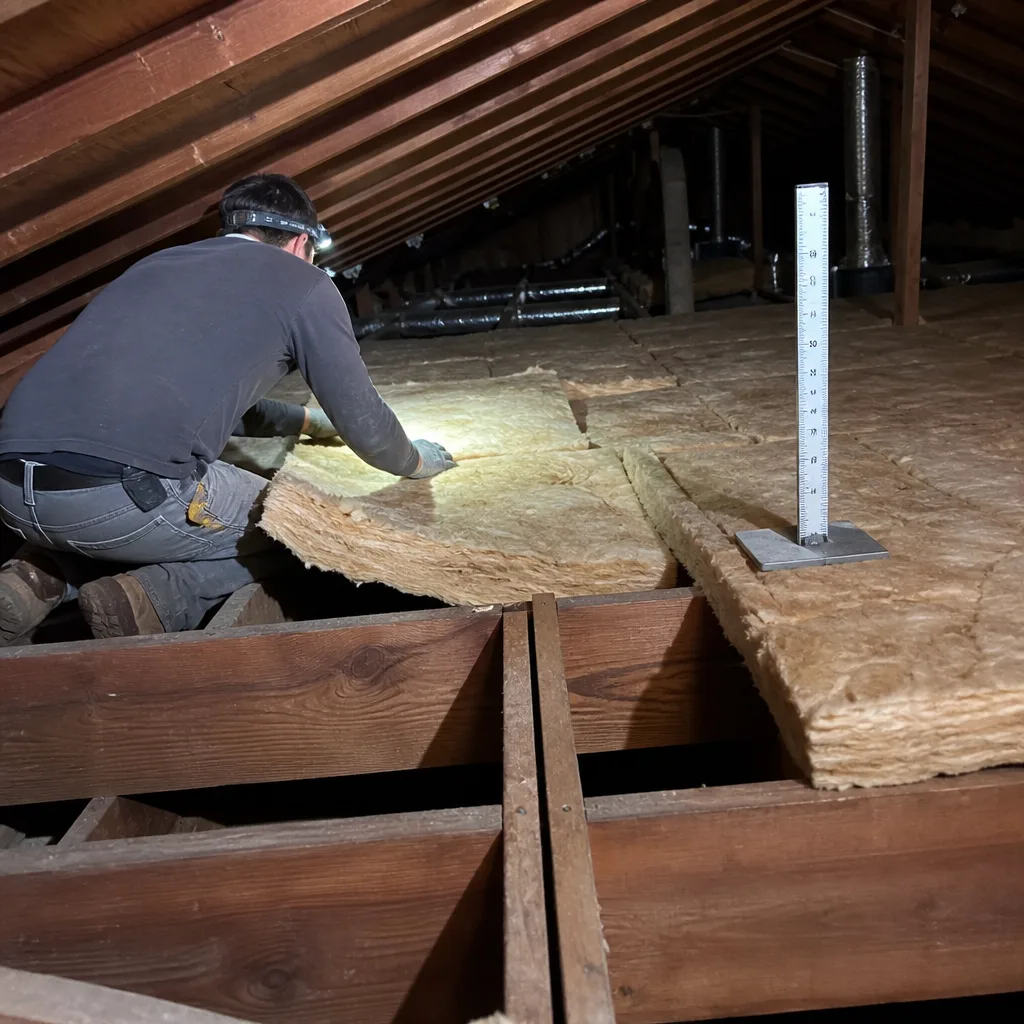
By September, Palo Alto attic temperatures have spent three months above 110°F. The roof deck, often dark composite shingle or aged tile in the older tracts, stores and reradiates heat well into October. This is when we find the most compressed fiberglass, the most brittle spray foam surface skins, and the most degraded radiant barrier facing.
The critical fall task is verifying ventilation net free area, the unobstructed square footage through which attic air can exit. California Title 24 requires 1 square foot of net free vent area per 150 square feet of attic floor, or 1:300 when 40-50% of ventilation is at the eave. Most Palo Alto homes built before 1980 fall short of this ratio because original soffit vents were painted over, blocked by added insulation, or never installed in the narrow eaves common to Eichler and ranch-style construction.
Here’s what to check:
- Locate every soffit vent. Walk the perimeter with a flashlight. Look for rectangular or circular grilles in the overhang. In Palo Alto’s Old Palo Alto neighborhood, many 1920s Craftsman homes have continuous wood soffits with no vents at all, a design that predates attic insulation.
- Check for blockage. From inside the attic, pull back insulation at the eave. If you see plywood, cardboard baffles stuffed with debris, or insulation packed against the soffit opening, net free area is compromised. We regularly find original Rockwool batts from the 1960s slid forward and packed against soffit vents in Midtown Palo Alto ranches.
- Verify ridge or gable vent function. Ridge vents clogged with dust or paint seal the attic like a jar. Gable vents blocked by storage items or bird nests create the same problem. Without exhaust, intake vents become decorative.
- Inspect insulation surface condition. Fiberglass that appears yellowed, flattened to less than half its original thickness, or dust-impregnated has lost R-value. Cellulose that has settled into a hard crust, common after multiple hot seasons, needs assessment for density and moisture content.
Fall is also the optimal window for air sealing before winter condensation risk rises. Top plates, the horizontal framing member where interior walls meet the ceiling, leak conditioned air continuously. In Palo Alto’s climate, a 2,000 square foot home with unsealed top plates and can light penetrations can lose 15-20% of heated air through the attic in winter. We seal these with fire-rated caulk and cover plates before adding any insulation, a sequence we document with before-and-after blower-door readings on every applicable job.
Attic Insulation in Palo Alto covers our full assessment and installation protocol, including how we publish blower-door numbers so you can verify the air-sealing result.
Winter (December-February): Condensation and Moisture Control
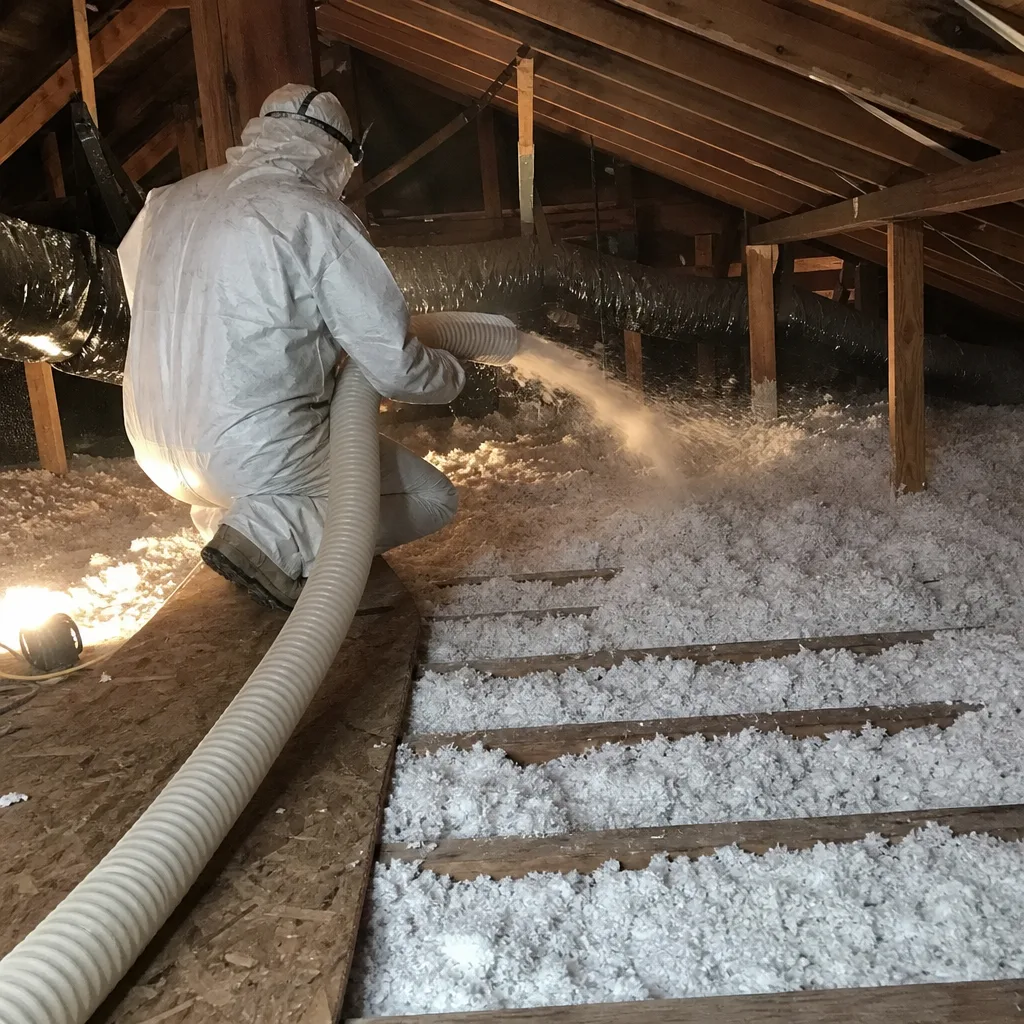
Palo Alto winters are mild by national standards but thermally active in ways that damage insulation. The Pacific marine layer keeps relative humidity elevated, and clear January nights allow roof surfaces to drop below the dew point of interior air that escapes into the attic. When that moist air contacts cold sheathing, condensation forms at the eave line first, where roof deck temperature drops fastest.
The dew point threshold for Palo Alto’s micro-climate typically falls between 38°F and 45°F in winter, depending on interior humidity. A home kept at 68°F and 40% relative humidity has a dew point of approximately 43°F. On nights when the roof deck drops below this temperature, any air leakage path into the attic becomes a condensation source.
Signs to monitor:
- Dark staining at the eave line, particularly on the north-facing roof slope where sun exposure is minimal. This is often the first visible indicator of recurring condensation.
- Frost on nail points protruding through the roof deck on cold mornings. The nails are thermal bridges, conducting cold to the interior surface where moisture condenses and freezes.
- Damp or clumped cellulose near chimney chases, plumbing vents, or electrical penetrations. Cellulose absorbs moisture readily; once damp, it compacts and loses both R-value and fire-retardant effectiveness.
- Musty odor at the attic hatch when opened on cold, humid mornings. This indicates active microbial growth, typically on wood surfaces rather than in the insulation itself.
Unvented attics, increasingly common in new Palo Alto construction and some deep energy retrofits, face a different winter risk. Without passive ventilation to remove moisture, these assemblies rely entirely on airtightness and vapor control. A single failed seal at a duct boot or a gap in spray foam application can introduce enough moisture to saturate the roof sheathing over a season. We verify unvented attic assemblies with moisture meters at multiple sheathing locations and compare readings to ambient attic conditions.
The Haven Standard requires that we document moisture findings with photography and written notation before recommending any insulation work. Adding insulation over damp sheathing traps moisture and accelerates decay. We’ve seen this in Barron Park and Greenmeadow homes where well-intentioned homeowners added fiberglass batts over existing moisture damage, sealing the problem inside the assembly.
Spring (March-May): Post-Rain Leak Detection and Material Assessment
Palo Alto’s rainy season peaks January through March, but roof leak migration into insulation often becomes visible only in spring as temperatures rise and evaporation begins. The critical spring task is distinguishing active leaks from historical staining, and water damage from mold colonization, so that remediation targets the actual problem.
Water staining patterns differ by insulation type. In fiberglass batts or blown fiberglass, water tracks vertically along framing members and leaves clean, yellow-to-brown stains with defined edges. The glass fibers don’t absorb water, so staining is surface-only and the material typically dries without structural change if the leak is repaired. In cellulose, water spreads laterally through the fiber matrix, creating diffuse, gray-to-black patches with no clear boundary. Cellulose that has been wet and dried multiple times develops a characteristic crusted surface and reduced loft.
Mold identification requires context. In fiberglass, visible mold growth is typically sparse, appearing as dark pinpoint colonies on the surface where dust has accumulated. The glass substrate doesn’t support extensive colonization. In cellulose, mold can be more extensive but is often misidentified; the gray-black discoloration from wetting and oxidation looks similar to active mold. A simple field test: damp cellulose with a musty, earthy odor likely has active microbial growth. Dry cellulose with uniform gray discoloration and no odor is typically oxidized, not moldy, though professional assessment is warranted if occupants have respiratory sensitivity.
Spring inspection protocol:
- Wait 48 hours after the last rain. This allows active leaks to manifest and eliminates false positives from surface wetting.
- Inspect with a bright, angled light. Raking light across insulation surfaces reveals staining that overhead lighting misses. We use 1,000-lumen work lights positioned at attic floor level.
- Check all penetration flashings. Plumbing vents, chimney crickets, and skylight curbs are the most common leak sources in Palo Alto’s varied housing stock. The original Eichler flat roofs, still present in neighborhoods like Fairmeadow and Southgate, require particular attention at membrane seams and drain locations.
- Photograph everything before disturbing. Insurance claims and contractor warranties require documentation of pre-existing conditions. Our Documented Photo Record on every visit captures this automatically.
- Test suspect areas with a moisture meter. Wood sheathing above 20% moisture content indicates active wetting. Insulation itself is harder to test; we remove samples and weigh them against known dry weights for that material type.
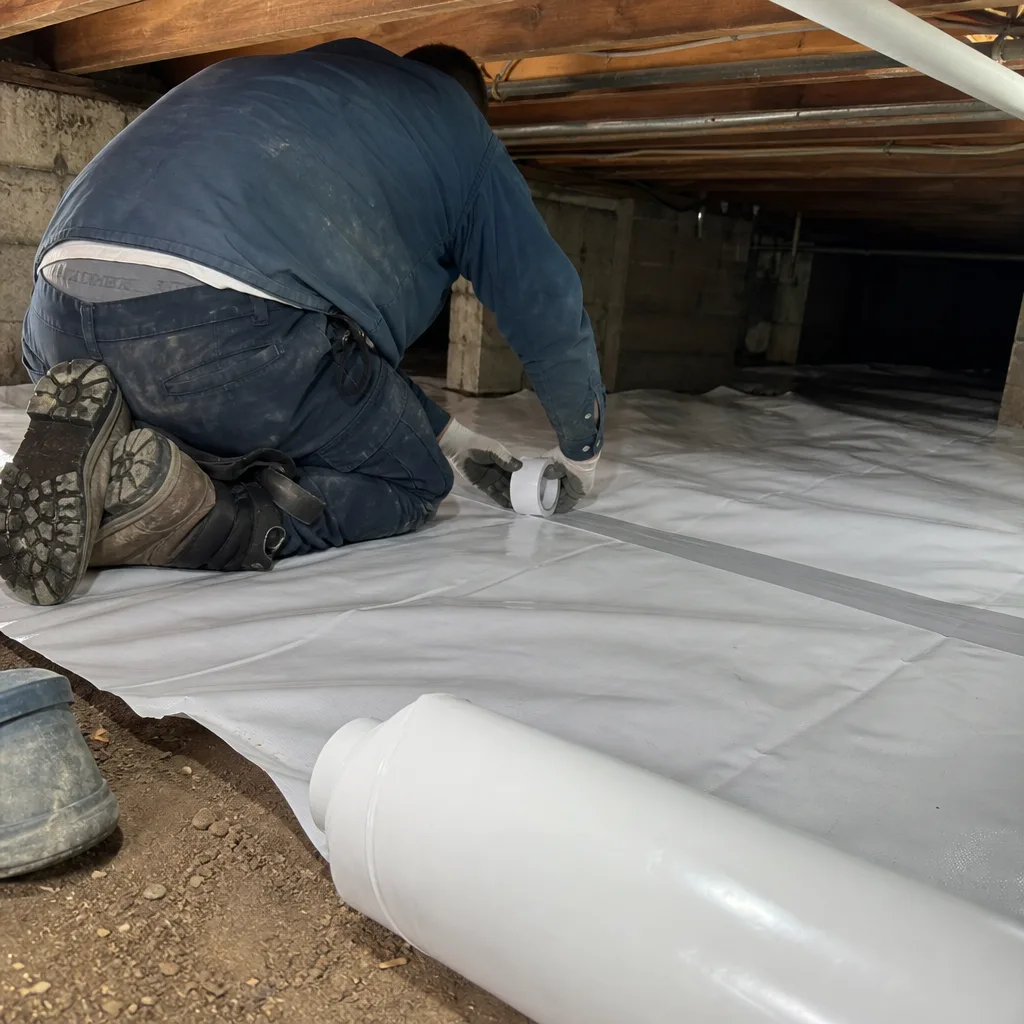
Spring is also when rodent activity becomes visible in Palo Alto attics. Roof rats, common throughout Santa Clara County, establish nests in insulation during winter and leave compressed trails, droppings, and urine staining by March. These materials require removal and replacement, not surface cleaning, and the access points must be sealed before new insulation is installed. Our Crawl Space Encapsulation & Vapor Barrier in Palo Alto service addresses the substructure entry points that rats often use to access wall cavities and attics.
Summer (June-August): Radiant Barrier and Delta-T Verification
By June, Palo Alto attic temperatures begin their climb toward the September peak. Summer maintenance focuses on verifying that radiant barriers are performing and that attic temperatures remain within a manageable delta-T, the temperature difference between attic air and conditioned living space.
A $20 infrared thermometer, available at any hardware store, is sufficient for homeowner verification. Here’s the measurement protocol:
- Take a living space reading at ceiling level in a central room, away from supply registers. Record the temperature.
- Enter the attic during late afternoon, between 3:00 and 5:00 PM, when attic temperature peaks. Stand on the attic floor or a secured walkway; do not walk on insulation or drywall.
- Point the infrared thermometer at the attic air, not at the roof deck. Aim toward an open area away from ductwork or the attic hatch. Record the temperature.
- Calculate delta-T. Subtract living space temperature from attic temperature.
What the reading means:
- Delta-T under 25°F: Attic ventilation and insulation are performing adequately. The conditioned space is not under excessive thermal load.
- Delta-T 25-40°F: Marginal performance. AC runtime is extended, and peak load strain is present. Improvement opportunities exist in ventilation, radiant barrier condition, or insulation depth.
- Delta-T above 40°F: Significant thermal bypass. In Palo Alto’s climate, this typically indicates blocked ventilation, degraded or insufficient insulation, or failed radiant barrier in homes where one was installed.
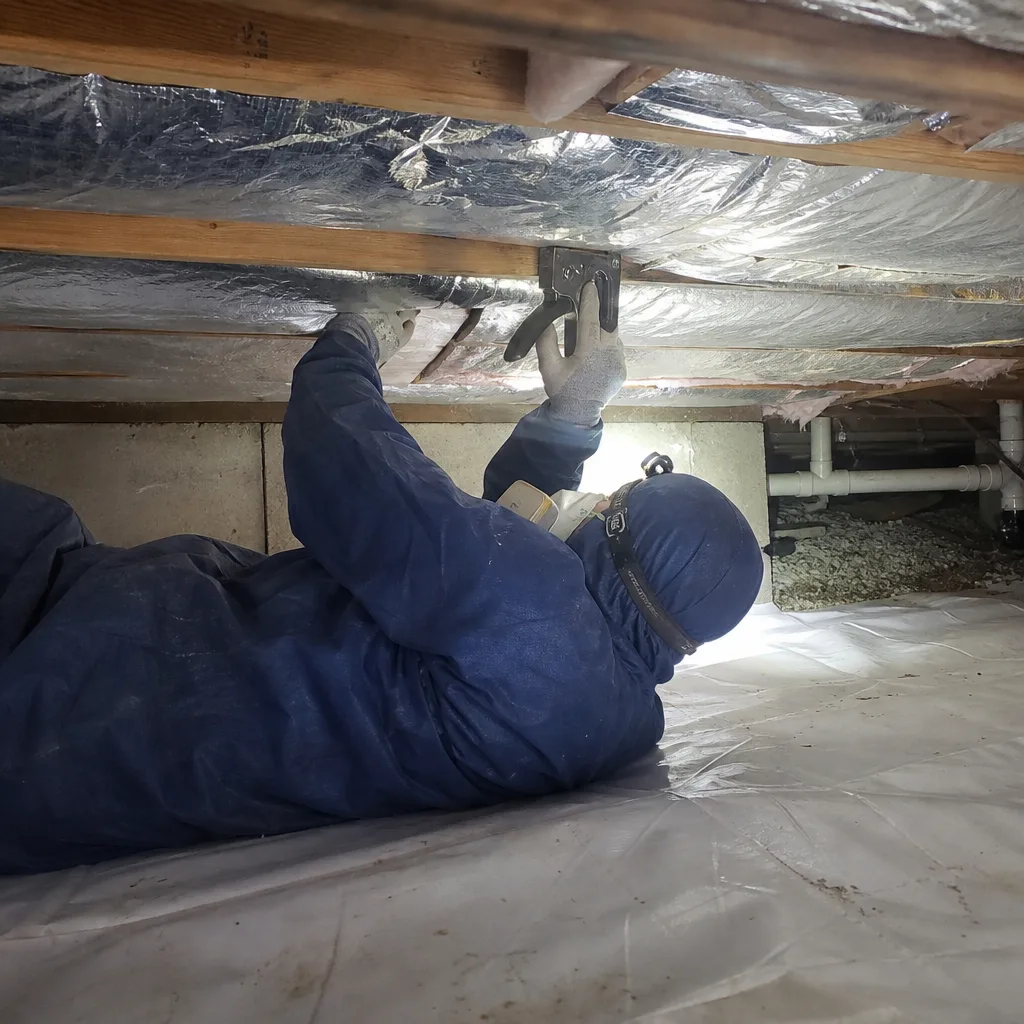
Radiant barrier inspection is straightforward but requires attic access during daylight. The reflective surface, typically aluminum foil laminated to oriented strand board or kraft paper, should face the attic air with at least 3/4 inch of clearance for convective cooling. Common summer failures include:
- Dust accumulation reducing reflectivity to below 50%. A clean radiant barrier reflects 95% of radiant heat; a dusty one may reflect less than 30%.
- Contact with insulation, eliminating the required air gap and converting the barrier to a conductor.
- Oxidation or corrosion in attics with historical moisture problems, appearing as white or gray mottling on the reflective surface.
- Punctures or tears from tradespeople accessing equipment, particularly in attics with HVAC air handlers or ductwork.
In Palo Alto’s Eichler and similar mid-century modern homes with flat or low-slope roofs, radiant barrier options are limited by structural constraints. Some homeowners opt for reflective roof coatings applied to the exterior, though these require reapplication every 5-7 years and are less effective than properly installed attic radiant barriers. For homes with adequate pitch, we install radiant barrier sheathing or draped foil systems as part of comprehensive attic upgrades, always after air sealing is complete.
Spray Foam Insulation in Palo Alto addresses homes where radiant barrier is impractical and where the thermal envelope requires a different approach to summer heat gain.
Year-Round: The Attic Access Log System
The most overlooked maintenance tool is also the simplest: a written log of every person who enters your attic, when they entered, and what they did. This practice, borrowed from commercial building management, prevents the gradual degradation that occurs when multiple trades access insulation without accountability.
Palo Alto homeowners typically have four categories of attic visitors: HVAC technicians for seasonal service or duct repair, pest control for rodent or termite inspection, roofing contractors for leak repair or replacement, and solar installers for panel maintenance or inverter service. Each visit carries risk: displaced insulation creating thermal bypasses, damaged vapor barriers, new penetrations left unsealed, or equipment stored on insulation compressing it to uselessness.
The access log format:
| Date | Service Provider | Technician Name | Work Performed | Insulation Condition Before | Insulation Condition After | Photos Taken? |
|---|---|---|---|---|---|---|
| Example: 03/15/2024 | ABC HVAC | J. Martinez | Coil cleaning, duct inspection | Batts intact, no displacement | 3 batts displaced at air handler; repositioned | Yes, 4 photos |
We provide a blank log template on every job where we perform attic work, and we fill out our own entry before leaving. The Haven Standard includes this as part of the documented record delivered at job completion. Over five to ten years, the log becomes a maintenance history that reveals patterns: the same HVAC contractor displacing insulation annually, a roof repair that preceded staining, or gradual compression from repeated foot traffic in the same path.
For homeowners in Palo Alto’s older neighborhoods, where attics are often small and access is through a closet or hallway ceiling, the log is particularly valuable. These tight spaces suffer disproportionate damage from each entry, and the cumulative effect of unlogged visits is often a 20-30% R-value reduction that no single contractor caused or acknowledged.
Common Mistakes to Avoid
- Inspecting only in spring. Spring inspections miss September heat damage entirely. By March, compressed fiberglass has settled and the evidence of peak thermal stress is buried under cooler-season appearance. Schedule at least one fall inspection.
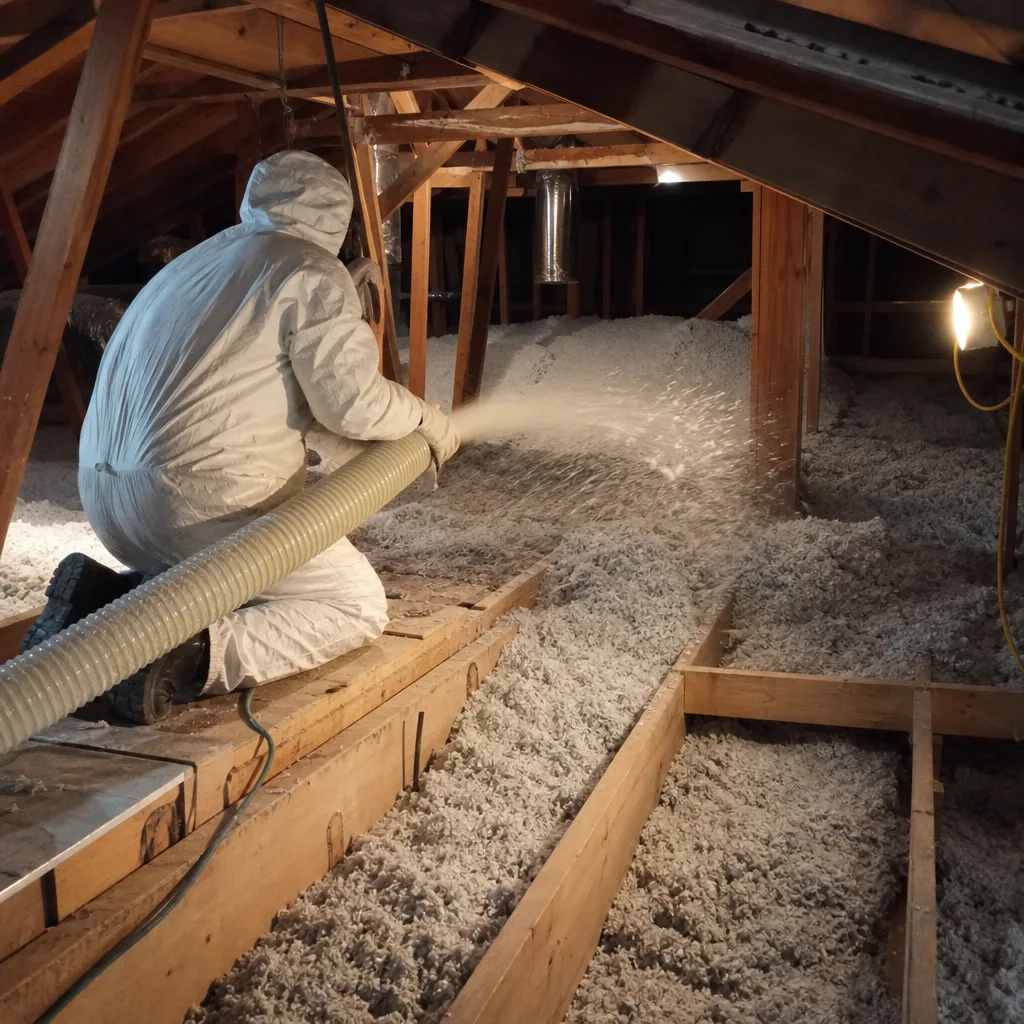
- Adding insulation over unsealed air leaks. This is the most common error we correct in Palo Alto homes. Blown fiberglass over a leaky attic floor acts as a filter, trapping dust and creating a permanent thermal bypass. Air sealing must precede insulation, always.
- Blocking soffit vents with added insulation. Well-intentioned depth upgrades often cover the very vents that make the insulation effective. Install baffles, cardboard or foam channels that maintain airflow from soffit to ridge, before adding material at the eave.
- Ignoring the access hatch. The attic hatch is often the largest uninsulated surface in the ceiling plane. A 1/2-inch plywood hatch with no weatherstripping can leak as much conditioned air as a square foot of open wall. Insulate the hatch to match ceiling R-value and install compression weatherstripping.
- Assuming all wet insulation must be replaced. Fiberglass that has been wet once and thoroughly dried often retains most of its R-value. Cellulose that has been wet multiple times or remains damp for weeks requires removal. Indiscriminate replacement wastes money; targeted assessment saves it.
- Using compressed insulation R-value ratings. A batt labeled R-30 achieves that rating only at listed thickness, typically 9.5 inches for fiberglass. Compressed to 6 inches in a 2×6 cavity, the same batt performs at approximately R-19. Always verify installed thickness, not bag label.
- Failing to verify contractor documentation. Any insulation contractor should provide written scope, written price, and written warranty before work starts. Under Haven Standard Clause 1, we deliver all three. Contractors who won’t commit in writing should not access your attic.
When to Call a Professional
Call a professional when you find moisture at the eave line that reappears after drying, when insulation compression exceeds 30% of original thickness, when delta-T readings exceed 40°F consistently, or when multiple trades have accessed your attic in the past two years with no documented condition assessment. These indicators suggest envelope performance problems that homeowner inspection cannot fully diagnose.
We also recommend professional assessment before any major HVAC upgrade. A new high-efficiency heat pump in a leaky, underinsulated attic performs below its rating and may short-cycle, reducing equipment life. The optimal sequence is envelope first, mechanical second, with blower-door verification between.
Topside Attic Insulation Palo Alto home provides free estimates in Palo Alto and surrounding Peninsula communities. Call (650) 352-3577 to schedule. Every estimate includes a written price, written scope, and written warranty before any work is proposed. We also offer a Free Second Opinion on any written estimate from another contractor; bring us the scope and we’ll review it with you, line by line.
Frequently Asked Questions
Most attic insulation jobs in a Palo Alto home between 1,800 and 2,800 square feet run between $3,200 and $7,800, depending on existing material condition, accessibility, and whether air sealing is required before insulation is added. Our DIY vs Professional Insulation guide helps homeowners decide when to hire out. Homes with original knob-and-tube wiring, common in Professorville and Old Palo Alto, require electrical assessment before work begins, which adds $400-$800 if subcontracted. We provide a written price before any work starts, always, and offer a Free Second Opinion on any competing written estimate. Call (650) 352-3577 for an exact quote; estimates are free.
Yes, if the existing material is dry, uncompressed, and free of pest contamination. Blown fiberglass over existing batts is common and effective when the original material is in reasonable condition. Cellulose over wet or mold-affected fiberglass traps moisture and accelerates degradation. We assess existing material with moisture meters and visual inspection before recommending any layering strategy. The Haven Standard requires this assessment be documented with photos.
Inspect twice yearly: once in late September or early October to assess summer heat damage, and once in April after the rainy season ends. Add an inspection after any roofing repair, HVAC service, or pest control treatment that accessed the attic. The access log system described above makes this schedule automatic rather than forgettable.
California Title 24 requires R-38 minimum for attic insulation in Climate Zone 4, which includes Palo Alto. However, performance depends on installation quality as much as rated R-value. An R-38 batt with 5% gaps and compression performs below a continuous R-38 blown system. We target R-38 to R-49 in most Palo Alto retrofits, with air sealing completed first so the rated R-value is the achieved R-value.
Spray foam, specifically closed-cell Icynene or Demilec products we install, excels in unvented attics and tight spaces where batts are impractical. It provides air sealing and insulation in one application. However, it costs 2-3 times more per R-value than blown fiberglass and requires professional installation with proper ventilation during curing. For vented attics with adequate access, blown fiberglass or Rockwool at proper density is typically the more cost-effective choice. We recommend based on building conditions, not product preference.
Calculate your attic floor square footage and divide by 150. The result is the required net free vent area in square feet. Then measure your actual vent openings, accounting for grille mesh and insect screening, which reduce effective area by 50-70%. If actual ventilation is below 50% of required, you have a problem. In Palo Alto’s humid winter and hot fall, insufficient ventilation accelerates both moisture damage and thermal degradation. Professional assessment with a flow hood provides precise measurement if calculation is uncertain.
The Bottom Line
Palo Alto’s climate demands season-specific insulation maintenance, not an annual generic checkup. Fall ventilation verification prevents the heat damage that peaks in September. Winter moisture monitoring catches condensation before it degrades materials. Spring leak assessment distinguishes repair needs from cosmetic concerns. Summer delta-T measurement with an infrared thermometer gives homeowners an objective performance metric without professional equipment. The year-round access log preserves these findings and prevents gradual degradation from undocumented trades access. Together, these practices maintain the envelope performance that insulation is supposed to provide. For more guides & resources, visit our blog. Neglect them, and even premium materials from Owens Corning, Knauf, or Rockwool underperform their ratings.
Written by Wes Okafor, Owner at Topside Attic Insulation Palo Alto, serving Palo Alto since 2016.